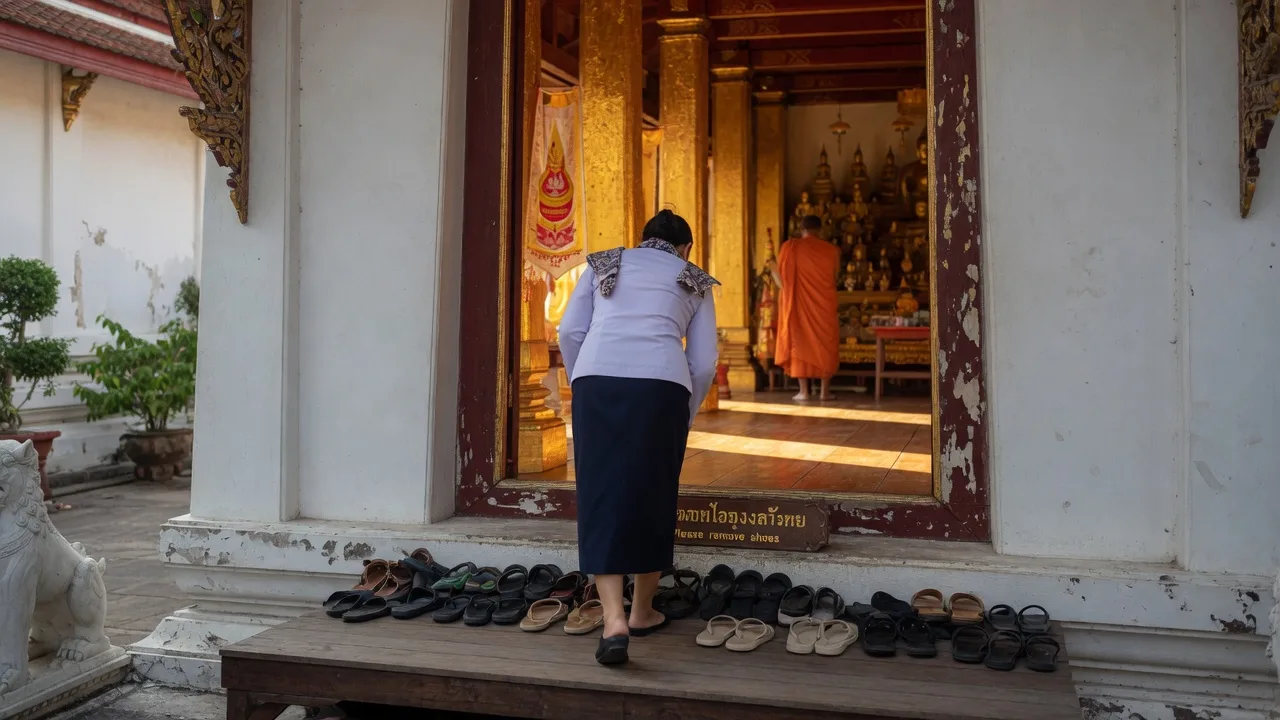
Thailand has on the order of 40,000 Buddhist temples. You will walk into more than one. The rules are not a costume brief for Instagram — they are how a living religion marks the difference between a courtyard and a hall where people still make merit. Get the dress right and the rest of the etiquette is mostly feet, volume, and not treating a Buddha image as a prop.
Dress by venue
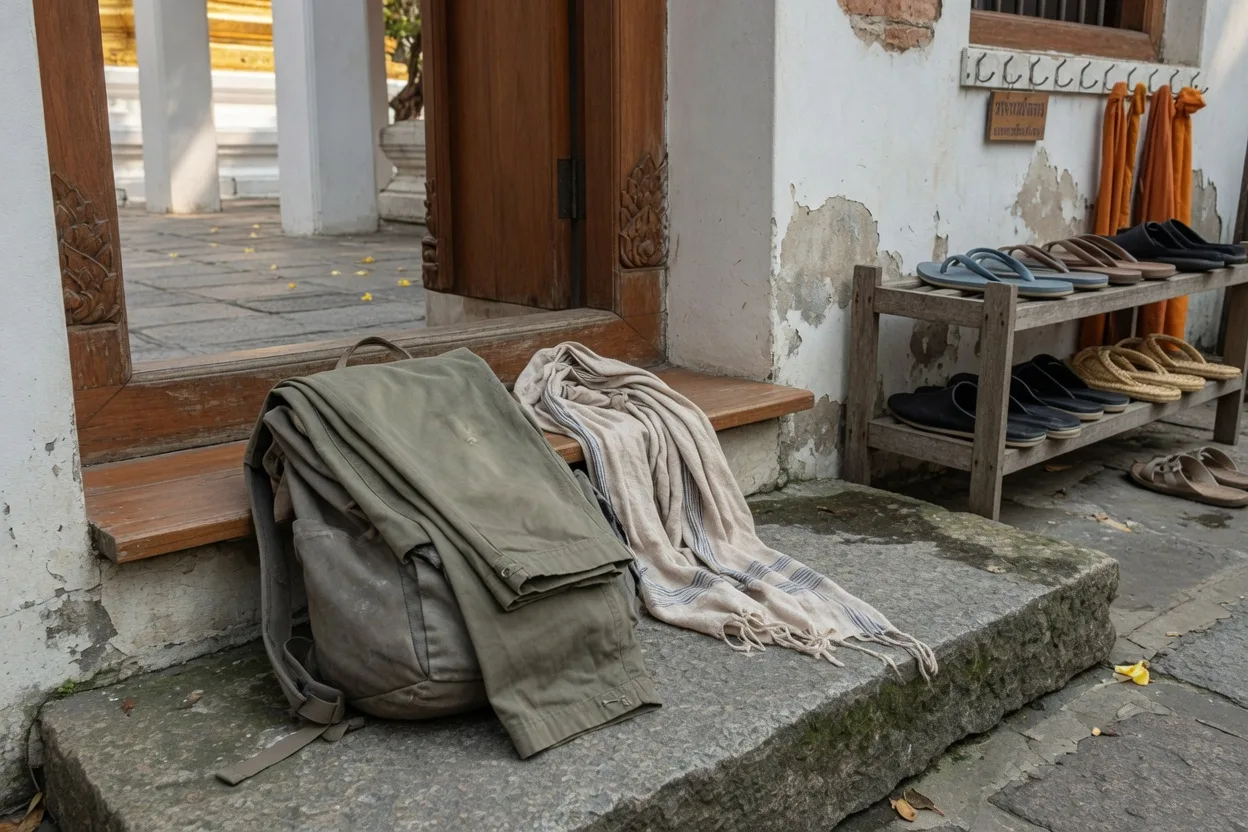
Shoulders and knees covered is the floor, not a Grand Palace quirk. A tank top that fails Wat Phra Kaew will also fail a surprising number of urban wats on a weekday morning. Lightweight trousers or a long skirt, a T-shirt with sleeves, and a scarf you can throw over if a strap slips: that kit covers 95% of gates.
| Venue | Shoulders / knees | Extra | Photos |
|---|---|---|---|
| Neighbourhood wat | Yes | Shoes off in the viharn; hats off | Usually fine in the courtyard; ask before the inner hall |
| Famous royal wat (Wat Arun, Wat Pho, Wat Phra Kaew) | Yes, strictly | No ripped jeans, no see-through, no hats inside | Inner ubosot often no photos; no climbing |
| Grand Palace complex | Yes, strictly | Wrap rental at the gate if you mis-pack; queues in heat | No posing with palace staff as comedy; no lying on the grass as a shoot |
| Active ubosot during a service | Yes | Sit at the back, phones away | Usually no |
Tank tops, short shorts, and football shirts with the midriff out are the usual bounce at ticketed sites. Staff would rather hand you a wrap than argue theology. Take the wrap. A lightweight linen scarf in the bag is cheaper than buying a sarong you will not wear again. Scarf listings are colour and size menus, so this stays a search.
Do not wear shoes you cannot slip off in three seconds. Laces on a 35 °C stone platform is how people get impatient and skip the rule.
Shoes, hats, and sitting
Shoes off at the threshold of any hall with a Buddha image — the viharn (assembly) and the ubosot (ordination hall). Leave them pointing out, not stacked on a chedi plinth or kicked toward an image. Hats off inside. Sunglasses off if you are sitting for more than a snapshot.
Sit so the soles of your feet do not point at a Buddha image. The “mermaid” pose — both legs tucked to one side — is what you will see locals do. Cross-legged is fine if your knees allow it and the feet still face away. Do not perch on a chedi, a naga balustrade, or a guardian statue for a photo. Those are not climbing frames; several high-profile visitors have been removed, fined, or deported for treating them as such.
If you need to pass in front of people who are praying, go behind them, or crouch slightly as you cross. You are not required to kneel if your knees will not, but towering over a seated row with a camera at eye height is the move that reads as tourist.
Voice, cameras, drones
Quiet in the hall. A viharn is not a gallery with a gift shop attached — though many wats have both in the compound. No tripod gymnastics. No ring-light. Flash is rude even when a sign has not banned it: gold leaf and dark wood do not need a strobe, and people making merit do not need to blink through your burst.
Some inner rooms forbid photos entirely. If a sign is in Thai only, watch what locals do with their phones. When in doubt, the courtyard is the photograph; the image in the hall is the reason the courtyard exists.
Drones over temple compounds are a separate offence on top of park and aviation rules. If the wat sits inside a national park, you now have two agencies who can ruin the afternoon. Leave the drone in the bag. See Park fees on Land & Sea.
Monks
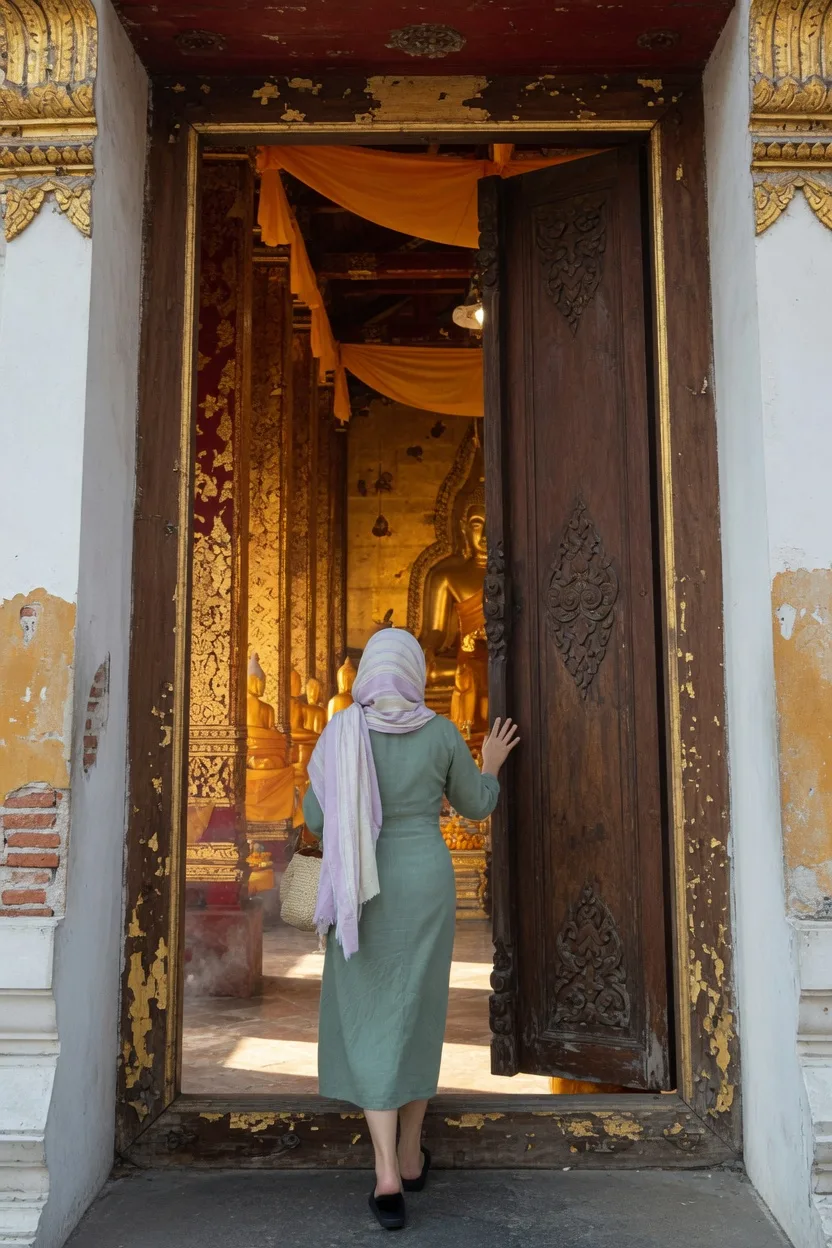
Give them space on the pavement, on the BTS, in the hall. A monk’s bowl in the morning alms round is not a photo-op first. If you want to offer food, buy it from the stall the locals are using and place it; do not rummage in your own bag for a granola bar.
Women do not hand objects directly to monks. Place the item on a cloth, a tray, or the ground, or pass it via a man. This is ordinary, not a slight. Sitting: leave a gap; do not take the seat immediately beside a monk on public transport if another is free.
Men who want to make a deeper offering can. You do not have to. A quiet wai as you pass is enough. Do not touch the robe. Do not ask a monk to pose with a beer, a peace sign, or your dog.
Most Thai men still ordain at least once, often for a short period. The teenager in saffron at a village wat may be a nephew on a two-week stay, not a career cleric. Treat the robe, not your guess at his CV.
Offerings
You do not have to buy a lotus. If you do, follow the person in front of you: typically three incense sticks, a lotus or a small flower cone, and a candle. Three sticks are a common reading of the Buddha, the Dhamma, and the Sangha — light them, plant them, kneel if you can, then give the space back.
Gold leaf on a seated image is a practice, not a craft souvenir. Press it where others have, usually the image, not a random patch of plaster. Cash in a donation box is fine and quieter than a theatrical envelope. There is no need to over-tip a blessing you did not ask for; a small note is courtesy, not a tariff.
Tickets, cash, and heat
Ticketed wats (Wat Pho, Wat Arun, the Grand Palace) take cash more reliably than your travel card. Opening hours skew morning; the Grand Palace queue in the afternoon sun is a self-inflicted injury. Water is allowed in the compound; eating in the inner halls is not.
A compact umbrella and slip-on shoes do more for this day than a new camera strap. Temple stone reflects; the scarf you packed for the gate is also shade.
A working sequence
- Check the gate dress line before you leave the hotel — scarf on in the taxi if you are already in a sleeveless shirt.
- Shoes off, phone on silent, hat in the bag.
- Courtyard first. Hall second. Inner ubosot only if it is open and you will sit.
- Offerings optional. Photos only where locals are already taking them.
- Leave the compound the way you found the shoe rack.
Next
Temples and monks, Buddhism in Thailand, Spirit houses, and the practical companion on Gateway: Etiquette guide.