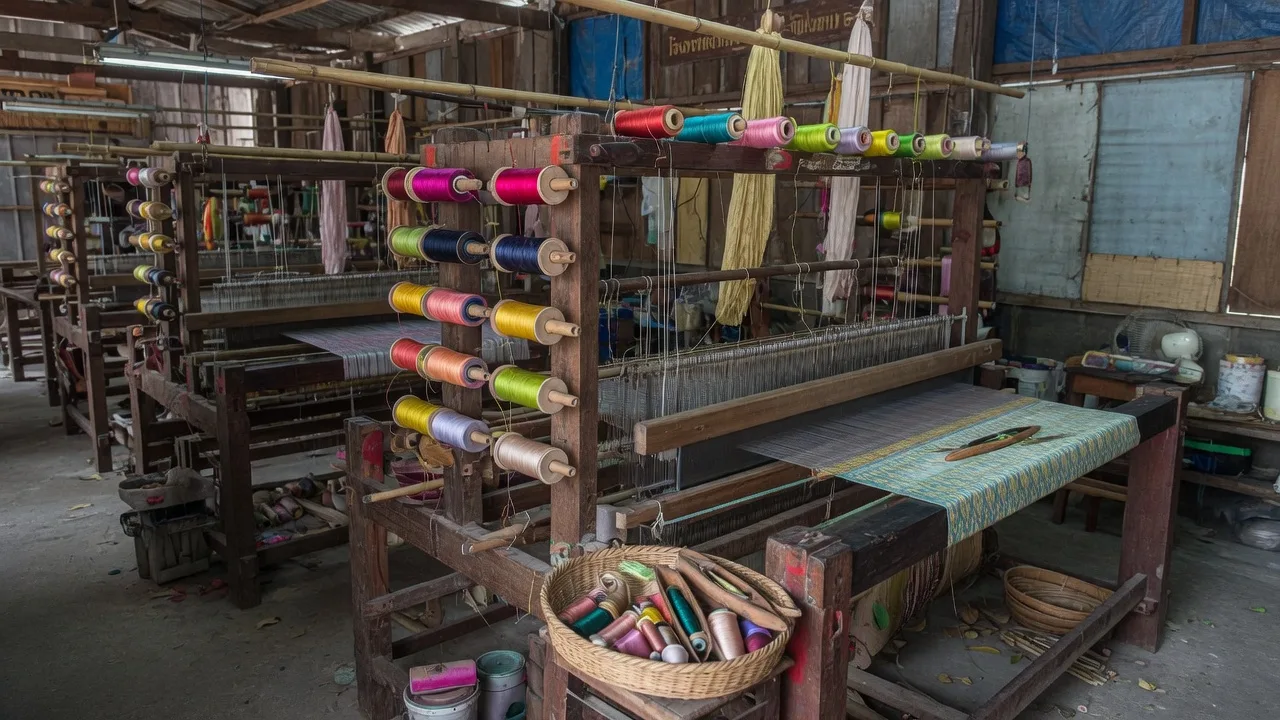
Thailand's craft traditions span millennia, from bronze-age pottery unearthed at Ban Chiang to the shimmering Thai silk that Jim Thompson introduced to the world in the 1950s. While modernity has displaced much traditional craftsmanship, Thailand remains one of Southeast Asia's richest repositories of living artisan cultures — particularly in the north and northeast, where communities continue to weave, carve, lacquer, and forge using techniques passed down through generations.
Thai Silk
The Art of Thai Silk
Thai silk is distinguished from other silks by several characteristics:
- Iridescence — Thai silk is traditionally woven with different-coloured warp and weft threads, producing a changeable sheen (shot silk) that shifts colour in different light
- Texture — Hand-reeled Thai silk has a slightly rough, nubby texture compared to the smooth finish of Chinese or Japanese silk. This is considered a feature, not a flaw
- Weight — Thai silk is heavier and more opaque than most Asian silks
- Durability — The rougher weave makes it exceptionally hard-wearing
Regional Silk Traditions
| Region | Speciality |
|---|---|
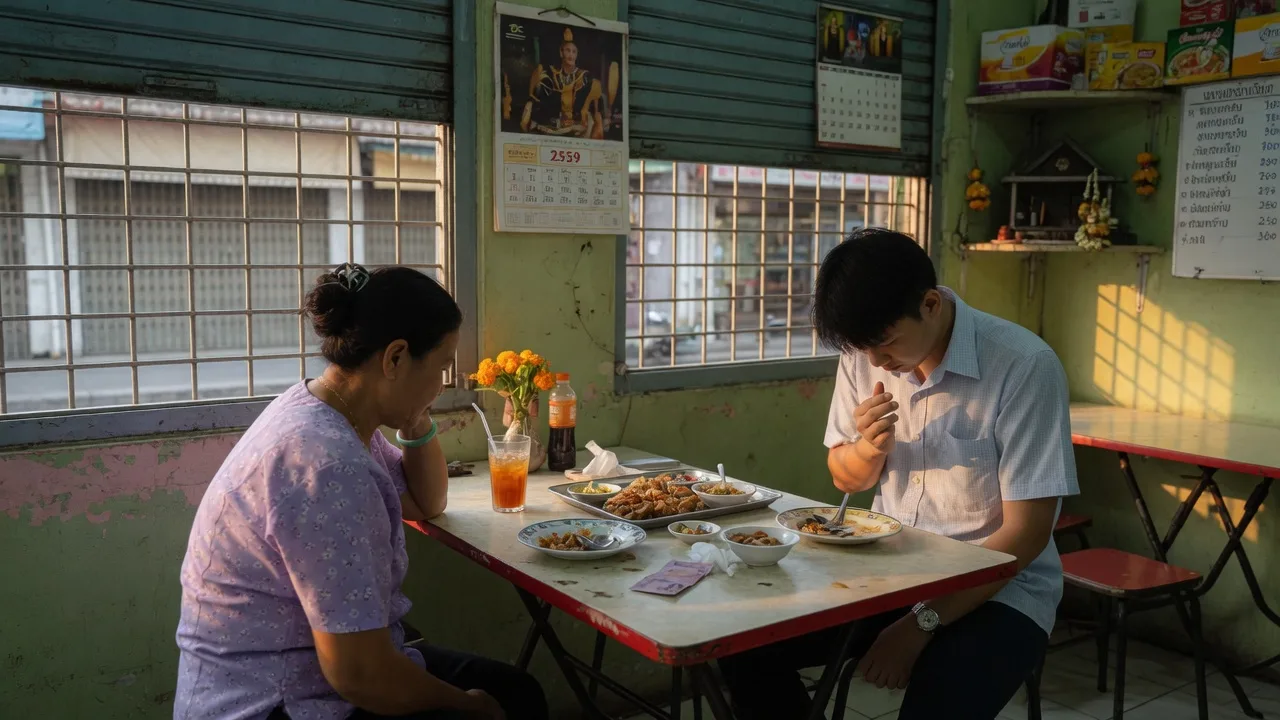
| Isan (Northeast) | The heartland of Thai silk. Mudmee (mat-mii) — ikat-dyed silk with geometric patterns. Villages like Chonnabot (Khon Kaen province) are famous |
| Surin Province | Known for traditional Khmer-influenced silk patterns and the annual Surin Silk Festival |
| Nakhon Ratchasima (Korat) | Jim Thompson's original production area. Pak Thong Chai district remains a workshop hub |
| Northern Thailand | Pha sin (tube skirts) and pha sabai (shawl scarves) in Lanna weaving traditions |

Jim Thompson
No discussion of Thai silk is complete without Jim Thompson (1906–1967?), the American architect turned OSS officer turned silk entrepreneur who single-handedly transformed Thai silk from a declining village craft into an internationally recognised luxury textile.
- Arrived in Bangkok after WWII, became fascinated with Thai silk weaving in the Ban Krua Muslim community along Saen Saep Canal
- Founded the Thai Silk Company in 1951
- Connected Thai weavers with Western couture houses, Broadway costume designers (notably for The King and I), and interior decorators
- Built his famous Jim Thompson House (now a museum) from six traditional Thai houses reassembled on the Saen Saep Canal
- Disappeared mysteriously in 1967 while hiking in the Cameron Highlands of Malaysia. His fate has never been determined.
The Jim Thompson House Museum in Bangkok is one of the city's finest cultural attractions — a living showcase of Thai domestic architecture, antiques, and art set in a tropical garden.
Buying Thai Silk
Authentic Thai silk can be identified by:
- A rough, slightly irregular texture (hand-reeled)
- Colour that shifts when held at different angles (shot silk)
- A distinctive smell — real silk has a faint, organic scent when burned (like burning hair)
- Price — genuine handwoven Thai silk is not cheap. A quality silk length suitable for a blouse will start from 1,500–3,000 baht
Best places to buy:
- Jim Thompson shops (flagship on Surawong Road, Bangkok) — reliable quality, contemporary designs, premium prices
- Chonnabot, Khon Kaen — buy directly from village weavers in Isan
- Chatuchak Weekend Market — mixed quality; inspect carefully
- Surin — during the annual silk festival in November
- Queen Sirikit SUPPORT Foundation shops — high-quality traditional textiles supporting rural weavers
Other Textile Arts
Cotton Weaving
Thailand's cotton weaving traditions are as rich as silk, particularly in the north:
- Pha khao ma (ผ้าขาวม้า) — The ubiquitous Thai men's check cotton cloth, used as a towel, sarong, sling, head covering, baby carrier, and all-purpose utility fabric. Every Thai household has several.
- Pha sin (ผ้าซิ่น) — Women's wrapped tube skirt, with regional variations in pattern and colour. Northern pha sin often feature intricate supplementary weft patterns along the bottom border.
- Hill tribe textiles — Hmong, Karen, Akha, Lisu, and Yao communities produce distinctive embroidered and appliquéd textiles. Hmong batik and Karen backstrap-loom weaving are particularly notable.
Natural Dyes
Traditional Thai dyeing uses:
- Indigo (from the indigo plant) — the classic deep blue
- Lac (from lac insects) — rich crimson
- Jackfruit heartwood — golden yellow
- Ebony fruit — black
- Turmeric — bright yellow
The revival of natural dyeing has become an important movement in sustainable Thai fashion.
Woodcarving
Northern Thailand, particularly Chiang Mai and the surrounding provinces, is renowned for woodcarving:
- Teak furniture — Chiang Mai was historically the centre of the Thai teak trade. While old-growth teak is now protected, plantation teak is used for carved furniture, panels, and architectural elements.
- Temple carvings — Lanna temples feature elaborate carved gables, door panels, and naga (serpent) barge boards. The finest examples are at Wat Phra Singh and Wat Chedi Luang.
- Ban Tawai — This village south of Chiang Mai is a massive woodcarving centre — essentially a village-sized workshop and showroom, with hundreds of artisans producing everything from picture frames to life-size elephants.
- Spirit houses — Carved and painted wooden or concrete spirit houses are a distinctive Thai craft, produced by specialist workshops.
Lacquerware
Lacquerware (khreung khon) is a Lanna specialty:
- Objects (boxes, trays, bowls) are formed from woven bamboo
- Coated with multiple layers of lacquer (traditionally from the Melanorrhoea usitata tree)
- Decorated with gold leaf, painted designs, or incised patterns
- Classic colours are black and red, with gold accents
- The finest lacquerware comes from Chiang Mai and, in the Shan tradition, from Mae Hong Son
Ceramics
Thailand has several ceramic traditions:
- Celadon — Chiang Mai is famous for celadon pottery (green-glazed stoneware), inspired by Chinese Longquan celadon but with distinctly Thai forms. This tradition dates back to the Lanna period.
- Benjarong — Five-colour (or more) porcelain with elaborate hand-painted designs, originally produced for the royal court. Authentic benjarong is painted freehand, not printed. Centres include Samut Songkhram province.
- Sangkhalok — Historical ceramics from the Sukhothai and Si Satchanalai kilns (13th–16th centuries). These stoneware pieces — plates, jars, figurines — were a major export item, found in shipwrecks across Southeast Asia. The ancient kilns are preserved at Si Satchanalai Historical Park.
Silverwork
- Chiang Mai's Wua Lai Road is the traditional silversmithing quarter. Repousse (hammered relief) silver bowls, boxes, and jewellery are a Lanna specialty. The Saturday Night Walking Street along Wua Lai showcases silversmiths at work.
- Hill tribe silver — Hmong, Akha, and Karen communities produce distinctive silver jewellery (neck rings, bracelets, belt chains) using traditional techniques.
Nielloware
Nielloware (khreung thom) is a uniquely Thai metalwork tradition:
- Silver or gold objects are engraved with intricate designs
- The engraved channels are filled with niello (a black alloy of silver, copper, lead, and sulphur)
- The contrast between bright silver and black niello creates striking decorative effects
- Nakhon Si Thammarat in southern Thailand is the traditional centre of nielloware production
- Items include bowls, boxes, jewellery, and royal regalia
Umbrella Making
Bo Sang village, east of Chiang Mai, is famous for handmade umbrellas and parasols:
- Frames crafted from bamboo
- Canopies of mulberry paper (sa paper) or silk
- Hand-painted with floral designs, landscapes, and mythological scenes
- The annual Bo Sang Umbrella Festival (January) features umbrella painting competitions and a colourful parade
Craft Revival and Sustainability
Several organisations work to sustain Thai crafts:
- The SUPPORT Foundation (established by Queen Sirikit) has promoted rural handicrafts since the 1970s, providing training, materials, and market access to village artisans across Thailand
- OTOP (One Tambon One Product) — A government programme encouraging each sub-district to develop and market a signature local product
- Thai Craft Fair Trade — Connects rural artisan groups with ethical buyers
- Contemporary Thai designers increasingly incorporate traditional techniques into modern fashion and homewares, creating new markets for ancient skills