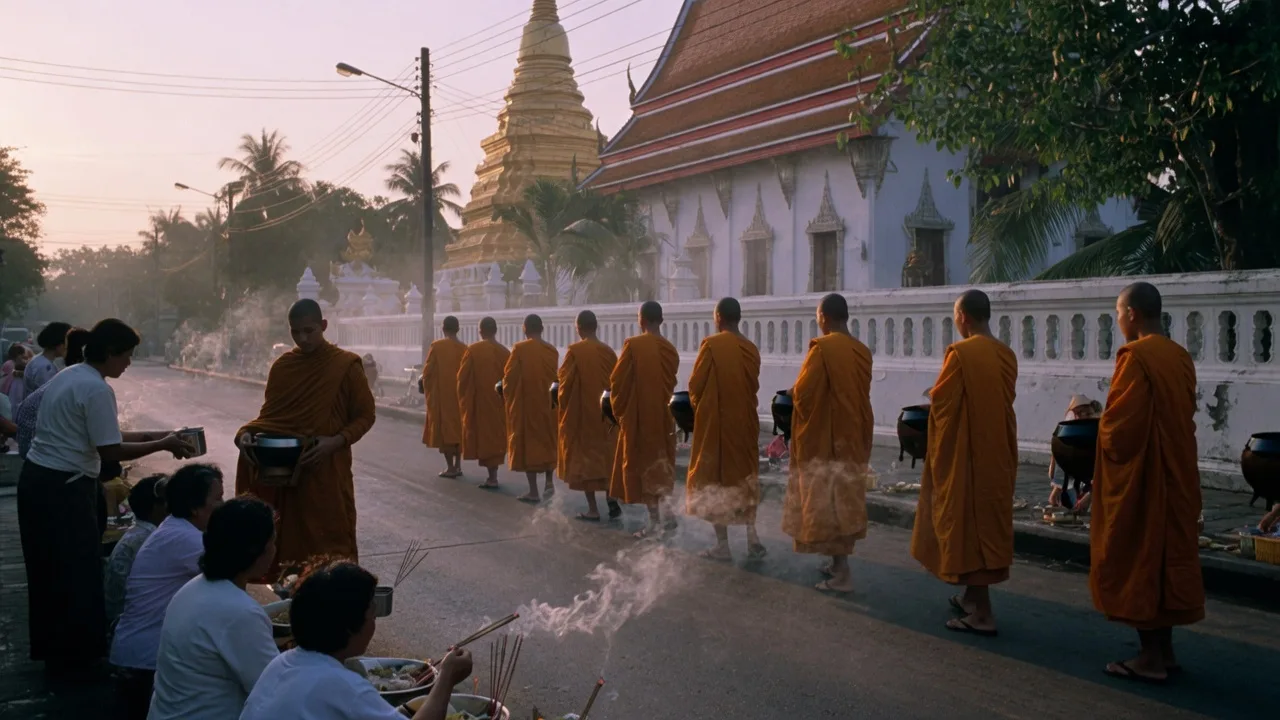
Buddhism is not a weekend overlay. About 93% of Thais identify as Buddhist. Theravada shapes the calendar, schools, architecture, and the day’s first transaction — rice into a monk’s bowl. On the order of 40,000 wats and about 300,000 monks. You will walk into more than one hall. How to behave in them is Temple etiquette. This page is what the hall is for.
Theravada
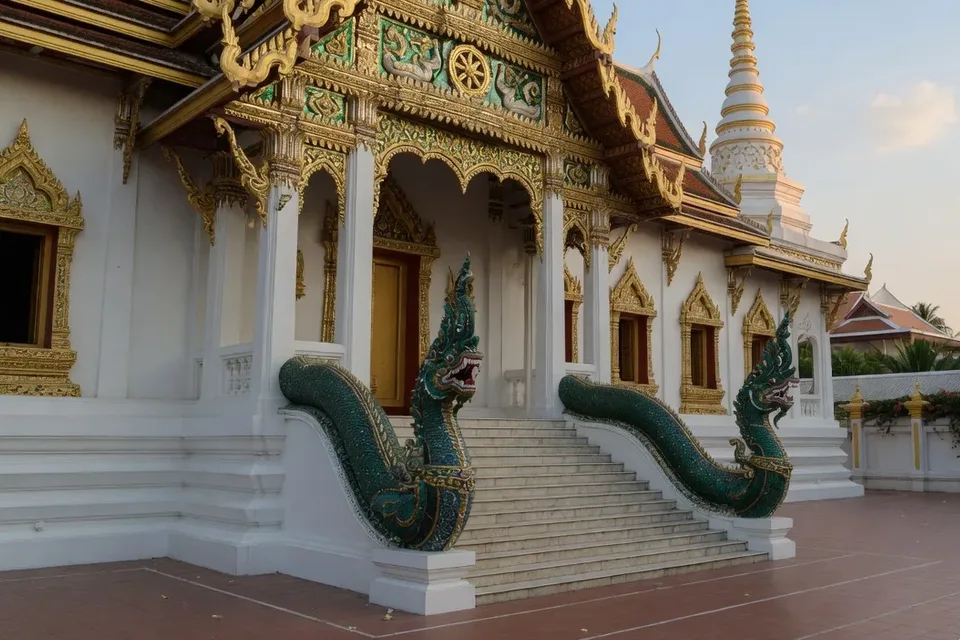
Thai Buddhism is Theravada (“Way of the Elders”), Pali Canon (Tipitaka) as the root texts:
- Practice is personal: ethics, meditation, wisdom
- Middle Way, not luxury, not starvation
- Four Noble Truths; Eightfold Path
- Karma and rebirth
- Sangha — monks as the field of merit for the laity
Mahayana (China, Japan, Korea, Vietnam) leans on bodhisattvas and a wider pantheon. Theravada stays closer to the historical Buddha and to monastic life as the serious path. In practice Thai Buddhism is also animist and Hindu-tinged. That is not a contradiction here. Spirit houses, Temples and monks.
Two monastic orders share the country: Mahanikaya (the large order) and Dhammayuttika / Thammayut, founded in the 19th century under Rama IV (Mongkut) as a stricter Pali-and-Vinaya reform. A visitor will rarely need the distinction at the door. The Thai forest tradition (kammatthana) — Ajahn Mun, Ajahn Chah, Wat Nong Pah Pong in Ubon — is the lineage Western meditation centres keep citing. Village wats still do funerals, schools, and the day’s alms; forest wats still do the walking path.
Mae chi — white-robed eight-precept nuns — are not fully ordained bhikkhuni in the Thai mainstream. They keep wats running and are easy to miss if you only photograph saffron. Do not treat them as extras.
Merit (tam bun)
Bun (merit) is the daily economy. The efficient way to earn it is to support the Sangha:
- Morning alms (tak bat)
- Donating to buildings
- Sponsoring an ordination
- Releasing birds and fish (the ethics of the supply chain are a separate argument)
- Precepts on wan phra
Merit can be transferred to the dead, which is why funerals are elaborate. It is not “buying heaven.” It is maintenance of a relationship between householders and monks.
Alms round
Before dawn, monks walk barefoot with bowls. Laypeople kneel and offer rice, curry, fruit, drinks. The monk does not thank you; you thank the monk for the chance to give. In tourist towns it has become a photo product. Do not block the line. Do not stick a camera in a bowl. Chiang Mai has had to publish manners for this reason.
Ordination
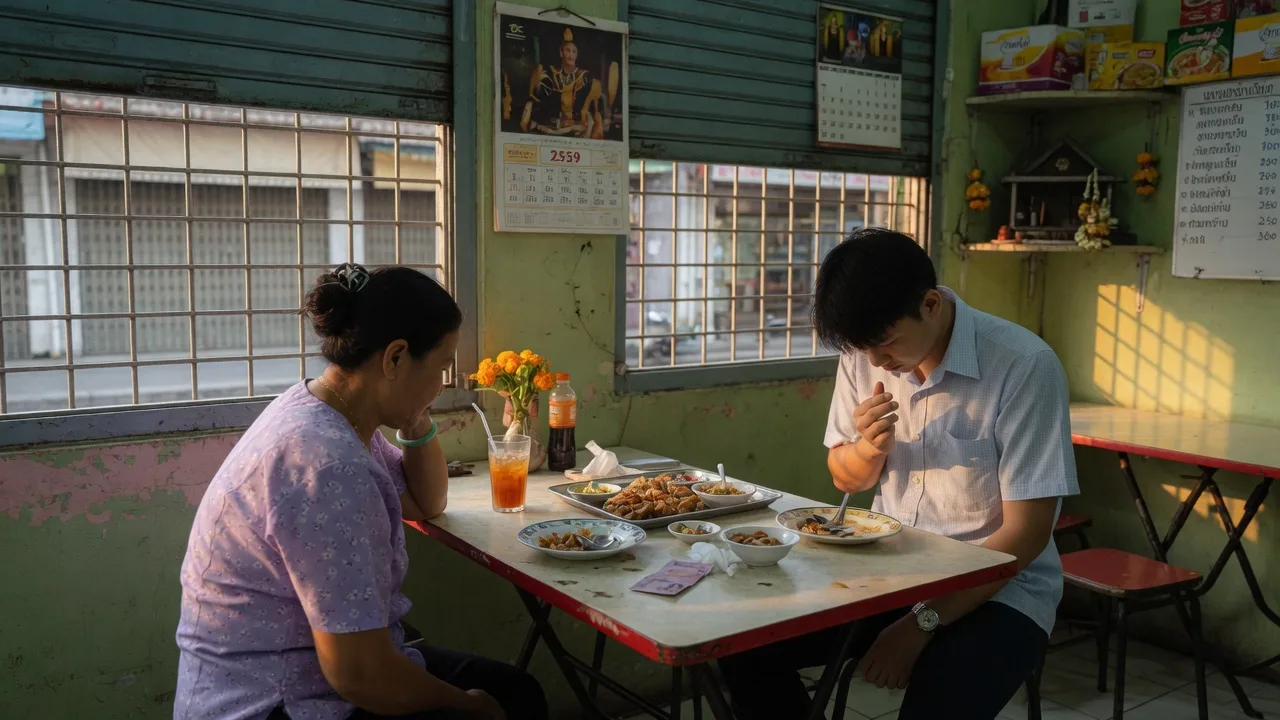
Most Thai men are still expected to ordain at least once, classically three months in the Rains Retreat (Phansa, roughly July–October). Rite of passage, merit for parents (especially mother), some Buddhist literacy, leave that employers still understand. Declining in cities; still ordinary in villages.
| Pin | Figure |
|---|---|
| Buddhist identity | ~93% |
| Temples | ~40,000 |
| Monks (order of magnitude) | ~300,000 |
| Alms | Daily, pre-dawn |
| Typical first ordination | Rains Retreat, weeks to three months |
| 2026 New Year water | Songkran 13–15 April |
| 2026 moon festival | Loy Krathong 24 November |

Lay practice on an ordinary week is the five precepts (no killing, stealing, sexual misconduct, lying, intoxicants). Wan phra (lunar quarter days) is when many take eight — extra rules on food after noon, entertainment, and a high bed. You will notice the eight as a white shirt at the wat, not as a lecture. Monks keep 227 Vinaya rules; that is the full-time job the alms round pays for.
Thai calendar. 7-Eleven will not sell beer on those days. Thai beer.
The wat, in parts
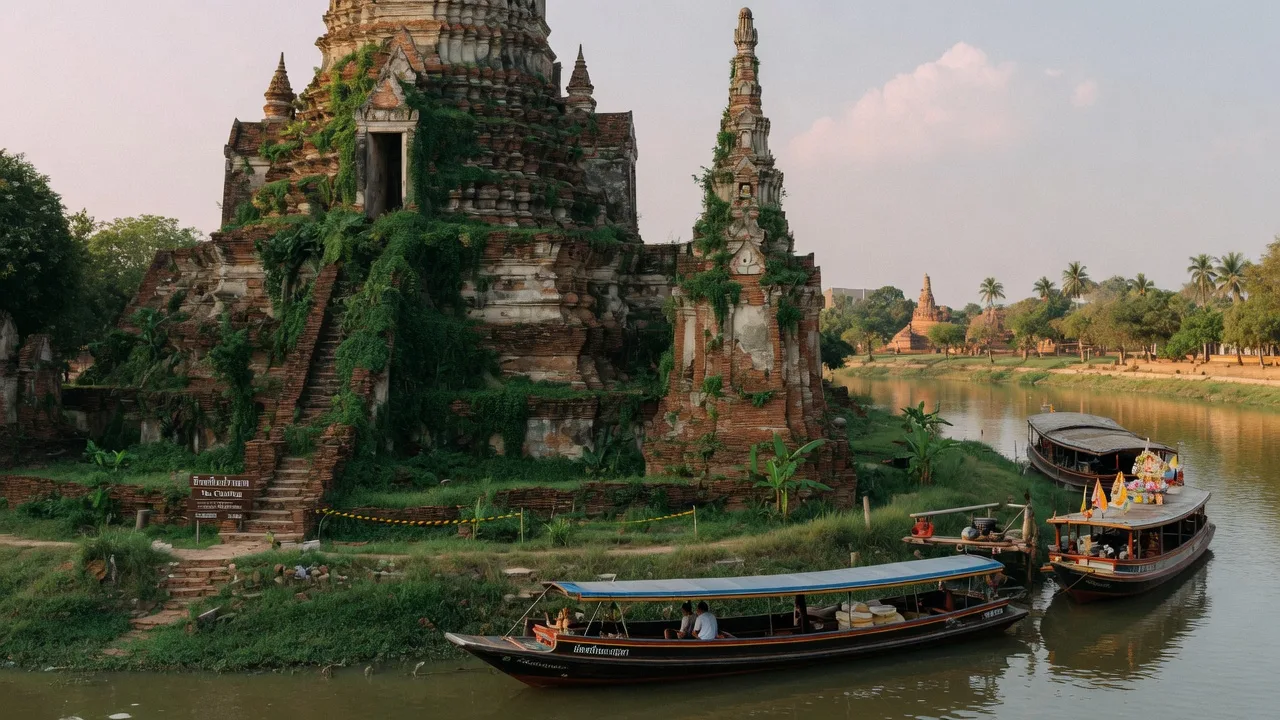
- Ubosot (bot) — ordination hall, most sacred, sema stones
- Viharn — assembly, principal Buddha, where laypeople sit
- Chedi — bell tower, relics
- Prang — Khmer-derived, pointed; Wat Arun’s silhouette
- Sala — open pavilion
- Kuti — monks’ cells
- Schools and welfare — many wats are still the village’s civic kit
Thai art and architecture. Gateway walking order: Temple trail.
Etiquette floor: shoes off; shoulders and knees; feet away from images; women do not pass objects hand-to-hand to monks; ask before inner-hall photos; no flash-as-strobe; no drone. A linen scarf and slip-ons — scarf listings are colour and size menus, so this stays a search. Land & Sea if the wat sits in a park: Park permits.
Spirits, amulets, ink
Animism did not leave. Spirit houses (san phra phum) stand outside almost every building. Amulets (phra phim) are a serious market. Brahman rites still run at court (ploughing ceremony). Sak yant tattoos from monks or ajarn — protection, not a holiday tramp stamp. Angelina Jolie is why your hostel friend wants one; the rule is still: know what you are putting on the skin.
The king is protector of Buddhism in the constitutional story. Do not fold the robe, the image, and the monarchy into a joke. The monarchy.
Merit food is still food. Table & Bazaar if you eat after the round: How to order. BE 2569 = 2026.
What “Theravada” actually changes on the ground
Thailand’s majority practice is Theravada, the same broad school as Sri Lanka, Myanmar, Laos, and Cambodia — not a boutique. The Pali canon, the monk as full-time specialist, and the laity’s job of feeding the robe are the operating system. Mahayana and Chinese-Mahayana temples exist in Bangkok’s Yaowarat and in Phuket; they are real, they are not the default village wat.
Most Thai men still ordain at least once, often for days or weeks rather than a career. The teenager in saffron at a provincial bus stop may be on a school-holiday stay. Treat the robe, not your guess at his CV. Women who want a deeper practice look for mae chi (white-robed nuns) and a smaller set of fully ordained bhikkhuni communities — the latter is politically contested; do not lecture a village abbot about it.
Morning alms (tak bat) is not a buffet photo. Buy food from the stall the locals are using, place it, step back. Do not rummage a granola bar from a daypack. Do not chase the line with a phone.
The calendar still runs the year: Makha, Visakha, Asarnha, Khao Phansa, Ok Phansa. 2026 CE is 2569 BE. Holy days are dry at retail. Thai calendar.
Next
Temple etiquette, Temples and monks, Spirit houses, Thai calendar, Songkran.