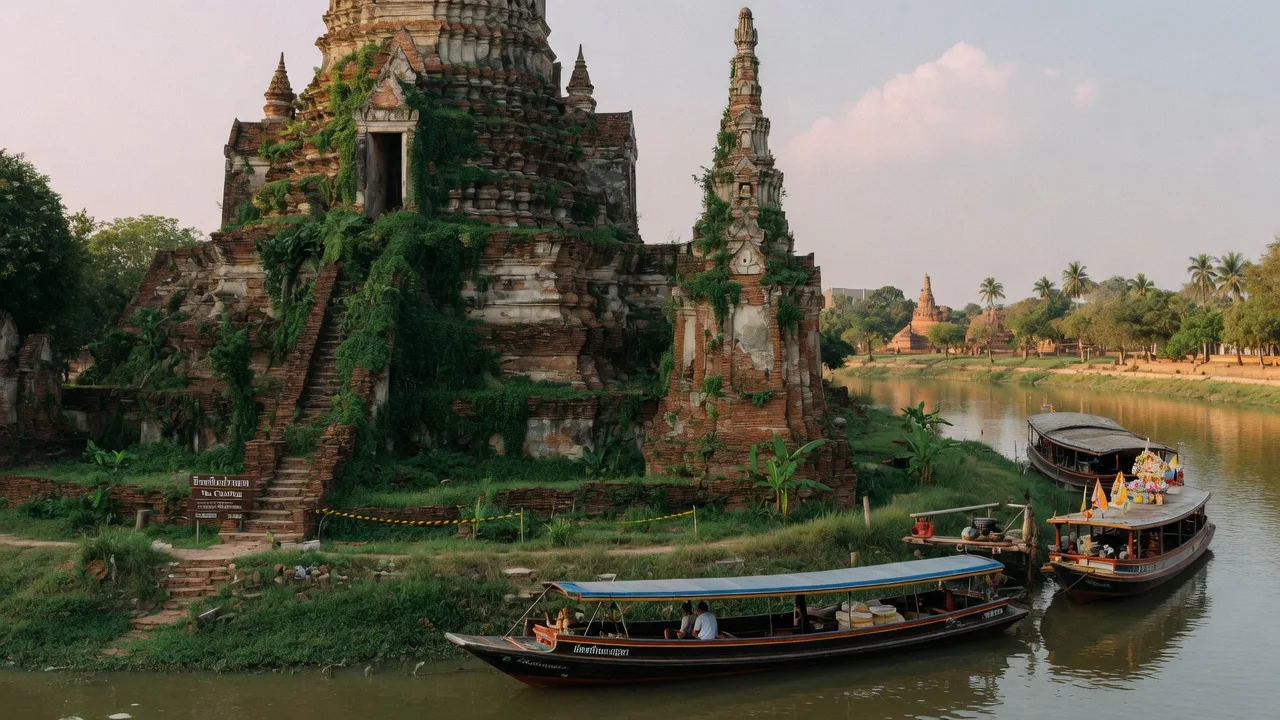
Ayutthaya (อยุธยา, officially the Kingdom of Ayutthaya or Krung Sri Ayutthaya) was one of the most powerful and wealthy kingdoms in Southeast Asian history. Founded in 1351 and enduring until its catastrophic destruction by Burmese armies in 1767, Ayutthaya stood for 417 years — outlasting the Ottoman Empire's classical period, the Ming Dynasty, and the entire European Renaissance.
At its peak, Ayutthaya was one of the largest cities in the world. European visitors in the 17th century described it as grander than London or Paris, with a population exceeding one million, golden spires visible for miles, and a cosmopolitan trading port where Japanese, Chinese, Indian, Persian, Portuguese, Dutch, French, and English merchants conducted business.
The Founding
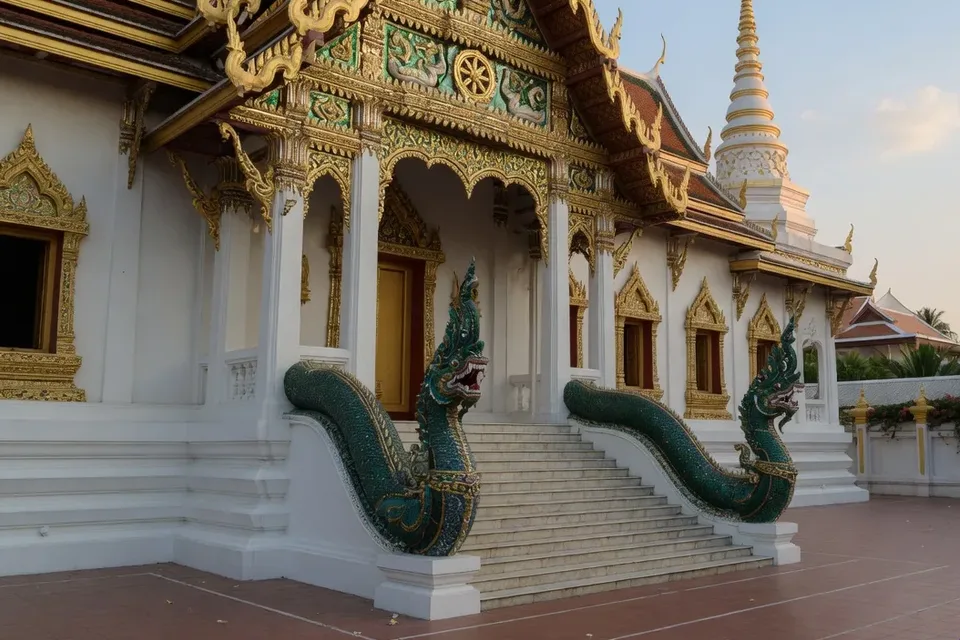
King U Thong (later Ramathibodi I) founded Ayutthaya in 1351 on an island at the confluence of three rivers — the Chao Phraya, the Pa Sak, and the Lopburi. The island location was strategic: surrounded by water, easily defended, and positioned on the trade routes connecting the sea to the interior.
Ayutthaya inherited and synthesised the traditions of earlier kingdoms: Sukhothai's Theravada Buddhism, the Khmer Empire's administrative systems and courtly ritual, and Dvaravati's Mon cultural legacy. The result was a civilisation of extraordinary complexity.
Government and Society
Divine Kingship
Ayutthaya adopted the Khmer concept of devaraja (divine king), elevating the monarch to semi-divine status. The king was:
- Lord of Life — absolute authority over all subjects
- Patron of Buddhism — builder of temples, supporter of the sangha (monkhood)
- Guardian of Dharma — upholder of religious law and social order
The court ritual was elaborate: the king appeared behind a curtain, his feet never touched the ground, and a special royal language (Rachasap) was used to address him — a practice that continues in modified form in modern Thailand.
Social Hierarchy
Ayutthayan society was rigidly stratified through the sakdina system — a numerical ranking assigned to every person, from the king (at the top) through nobles, officials, and commoners to slaves (at the bottom). The number determined your status, legal rights, and obligations. This system's echoes persist in modern Thai social hierarchies.
Administration
Ayutthaya developed a sophisticated bureaucracy:
- Four ministries (City, Palace, Treasury, Fields/Agriculture)
- Provincial governors (chao muang) appointed by the crown
- Legal codes (Kotmai Tra Sam Duang) codified in the 15th–17th centuries
- Corvée labour system requiring commoners to work for the state several months per year
International Trade
Ayutthaya's location made it a natural entrepôt — a meeting point for East-West trade. By the 16th–17th centuries, it was one of the most commercially important ports in Asia.
Trading Partners and Communities
- Chinese — The largest foreign community. Chinese merchants dominated internal and external trade. Intermarriage with Thais created the Sino-Thai community that remains a powerful economic force today.
- Japanese — A 1,500-strong Japanese community led by the adventurer Yamada Nagamasa occupied a district on the river. He rose to become a high-ranking noble before his assassination.
- Portuguese — The first Europeans to reach Ayutthaya (1511). They introduced firearms, cannons, and the architectural elements visible in surviving fortifications.
- Dutch — The VOC (Dutch East India Company) established a significant trading factory.
- French — In the 1680s, an extraordinary diplomatic exchange between King Narai and Louis XIV of France saw embassies travel between Ayutthaya and Versailles. The French attempted to convert the king to Christianity and increase their influence — an overreach that triggered a nationalist reaction.
- English and Danes — Smaller trading operations.
- Persian, Indian, and Malay — Merchants, mercenaries, and officials from across the Indian Ocean world.
Exports and Imports
Ayutthaya exported: rice, deerskins, sappanwood (for dye), tin, lead, saltpetre, benzoin (resin), and teak.
It imported: Chinese porcelain, silk, Japanese silver, Indian textiles, Persian horses, and European firearms.
War with Burma
Ayutthaya's history was punctuated by repeated conflicts with the Burmese kingdoms to the west:
- 1569 — First Fall of Ayutthaya — The Burmese captured the city after a protracted siege. The king and much of the court were taken to Burma. Ayutthaya became a Burmese vassal.
- 1584 — Independence Restored — King Naresuan the Great declared independence and defeated the Burmese in a legendary elephant-back duel with the Burmese crown prince in 1593. Naresuan is one of Thailand's greatest national heroes — his statue stands at Don Muang Airport.
- 1767 — Destruction of Ayutthaya — After a 14-month siege, Burmese armies breached Ayutthaya's walls and systematically destroyed the city. Temples were looted and burned, Buddha images were melted down for gold, the royal library was destroyed (a catastrophic cultural loss), and much of the population was killed or enslaved. The scale of destruction was deliberate and total.
Ayutthaya Historical Park
The ruins of Ayutthaya — 67 km north of Bangkok — are a UNESCO World Heritage Site (inscribed 1991). The island city retains the ghostly grandeur of its layout, with temple ruins, giant Buddha images, and crumbling prang towers scattered across a flat landscape encircled by rivers.
Key Sites
- Wat Mahathat — Famous for the Buddha head entwined in tree roots — one of the most photographed images in Thailand. The decapitated head was likely knocked from its statue during the Burmese destruction and gradually enveloped by a fig tree's roots.
- Wat Phra Si Sanphet — The royal temple, equivalent to Bangkok's Wat Phra Kaew. Three massive bell-shaped chedis once contained the ashes of three kings. The temple was the largest in Ayutthaya.
- Wat Chaiwatthanaram — A Khmer-style temple complex on the river, built in 1630. The most photogenic ruin in Ayutthaya, particularly at sunset when the prang towers are silhouetted against the sky.
- Wat Ratchaburana — Contains a crypt with remarkable murals — some of the only surviving Ayutthayan paintings — and a treasure cache discovered (and partially looted) in the 1950s.
- Wat Yai Chai Mongkhon — Dominated by an enormous reclining Buddha and a tall chedi. Active temple with a living monastic community amid the ruins.
Visiting
Ayutthaya is an easy day trip from Bangkok:
- Train: 2 hours from Hua Lamphong station (scenic, cheap)
- Minivan: 1.5 hours from Bangkok's Northern Bus Terminal
- Boat: Several operators run scenic river cruises from Bangkok to Ayutthaya (half-day or full-day)
- Cycling is the ideal way to explore the ruins — flat terrain, manageable distances
Legacy
The destruction of Ayutthaya was a national trauma that still resonates. But the civilisation's legacy survived:
- The new capital at Bangkok (Thonburi, then Rattanakosin) was explicitly modelled on Ayutthaya's layout and court traditions
- The royal rituals, legal codes, and administrative systems were reconstructed from memory and surviving documents
- The Thai national consciousness — "we were once a great empire, and we will be great again" — was forged in the fires of 1767
- Relations between Thailand and Myanmar remain coloured by this history, despite modern diplomatic normality