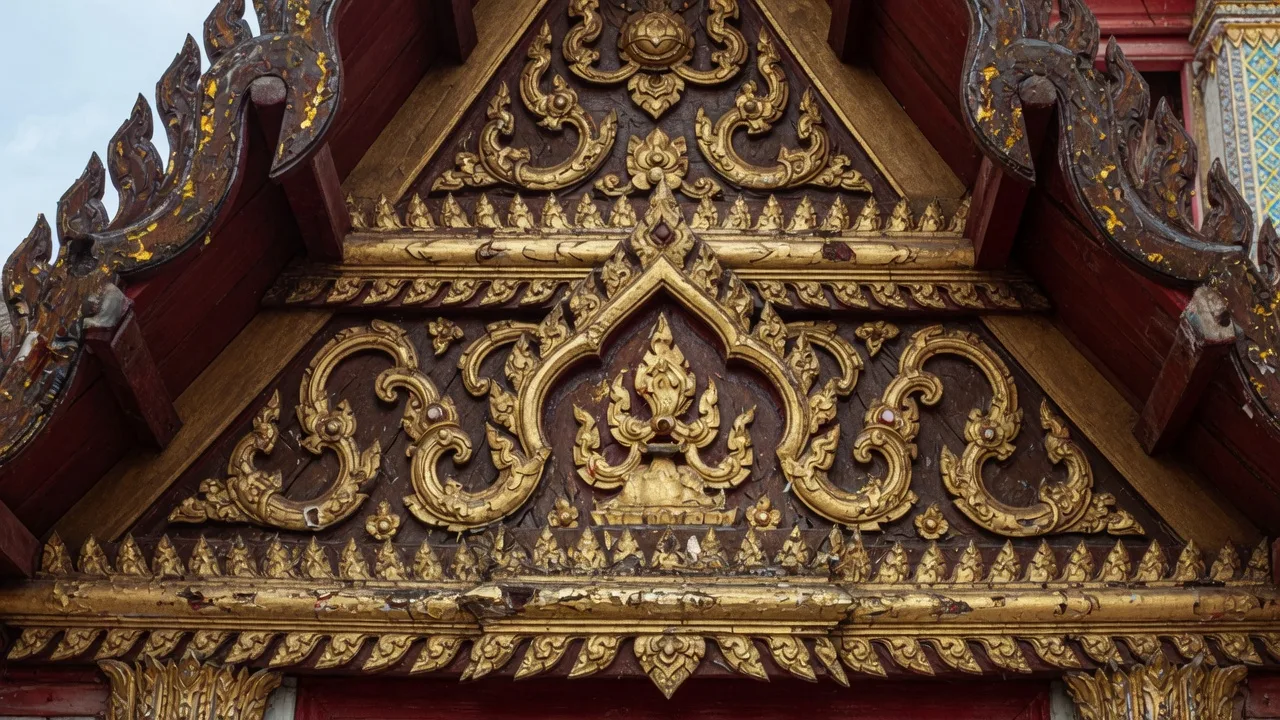
Thai art is overwhelmingly religious art. For centuries the volume of production — sculpture, painting, buildings, gold — served Buddhism: the Buddha’s lives, cosmology, merit, a hall you can still pray in. That did not make it narrow. Sukhothai’s Walking Buddha and Rattanakosin’s mirror-mosaic excess are the same civilisation at different temperatures.
Walk it, do not treat it as a backdrop. Temple etiquette. Gateway circuit: Temple trail.
Buildings by period
| Period | Tell | Example |
|---|---|---|
| Dvaravati (6th–11th c.) | Mon, laterite, Dharma wheels | Phra Pathom Chedi base, Nakhon Pathom |
| Khmer (9th–13th c.) | Sandstone prangs, Hindu lintels | Phimai, Phanom Rung |
| Sukhothai (13th–15th c.) | Lotus-bud chedis, Walking Buddhas | Wat Mahathat, Sukhothai |
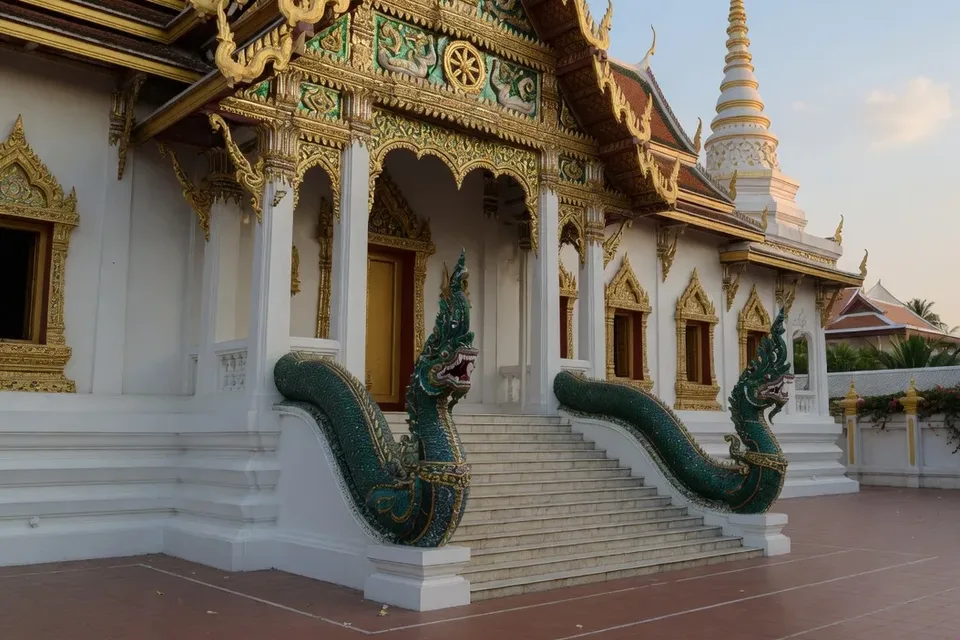
| Lanna (13th–18th c.) | Layered wooden roofs, carved gables, intimate scale | Wat Phra Singh, Chiang Mai |
| Ayutthaya (14th–18th c.) | Bell chedis, Khmer prang borrowed, more ornament | Wat Chaiwatthanaram |
| Rattanakosin (1782–) | Maximum gold, glass, Chinese porcelain | Wat Phra Kaew, Grand Palace |
Roof and naga
The recognisable Thai roof is multi-tiered, steep for monsoon, upturned eaves ending in chofa — stylised naga or garuda. Lanna roofs sit lower and wider, stacked. Central Thai roofs go sharper.
Naga is everywhere: stair balustrades, finials, boundary stones. Water, fertility, the line between human and not. You will trip over nagas before you learn the word.
Phra Pathom Chedi is often cited as the world’s tallest Buddhist monument at 120.5 m (some sources say 127 m including later work — the tower you see is not the 3rd-century stupa; that is underneath). Verify the plaque if you are collecting superlatives.
The words on the sign
| Word | What it is |
|---|---|
| Ubosot (bot) | Ordination hall; sema stones at the corners; most sacred |
| Viharn | Assembly hall; the Buddha you actually sit in front of |
| Chedi | Bell or lotus-bud relic tower |
| Prang | Khmer-derived corn-cob tower — Wat Arun’s silhouette, often cited ~70–82 m depending what is counted |
| Mondop | Square pavilion, often a scripture or footprint shrine |
| Ho trai | Library, frequently over water to keep insects down |
| Chofa | The bird/naga finial on the roof ridge |
| Bai raka | The serrated roof edge that reads as a naga’s back |

Wat Pho’s reclining Buddha is about 46 m long; the feet alone are ~3 m, inlaid with 108 auspicious signs in mother-of-pearl. The Emerald Buddha at Wat Phra Kaew is ~66 cm and wears three seasonal costumes the king changes — hot, rainy, cool. That is court ritual, not a costume change for tourists. Temples and monks, Temple etiquette.
Sculpture
Sukhothai is the high point of Thai Buddha images: the uniquely Thai Walking Buddha, oval face, aquiline nose, inner smile, flame ushnisha, elongated spiritual geometry.
Ayutthaya: more regal, crowned Buddhas, stiffer, jewellery as divine kingship.
Rattanakosin: gilded continuation. The Emerald Buddha at Wat Phra Kaew — about 66 cm, jadeite, royal dress, the most sacred image in the kingdom. Not jade in the tourist-shop sense; do not argue mineralogy with a guard.
Hindu-Buddhist overlap, still:
- Garuda — national emblem, Vishnu’s mount, royal seal
- Erawan — three-headed elephant, Indra’s mount, Erawan Shrine, Erawan park
- Brahma, Vishnu, Shiva in court rite
- Ramakien — Thai Ramayana, murals at Wat Phra Kaew, khon masked dance
The monarchy. Land & Sea’s Erawan falls are named for the same elephant: National parks overview.
Painting and performance
Temple murals: Jataka (especially the last ten, Totsachat), life of the Buddha, heavens and hells, court and street life, foreigners in funny hats.
- Wat Phra Kaew — Ramakien cloister
- Wat Phutthaisawan (Ayutthaya) — some of the oldest surviving
- Wat Phumin (Nan) — “whispering lovers”
- Wat Kongkharam (Ratchaburi) — trade and foreigners
Khon: masked dance-drama of the Ramakien, UNESCO Intangible Heritage 2018. Hero, heroine, demon, monkey — four movement vocabularies. Sala Chalermkrung in Bangkok is the serious contemporary house.
Also: lakhon (more fluid, historically female), northern fon, nang yai large shadow puppets, nang talung in the south.
Now
- BACC — Siam, free shows, the round building
- MOCA — north Bangkok, modern Thai collections
- Jim Thompson House — teak, silk, the American who made the industry a story
- Chiang Rai: White Temple (Chalermchai Kositpipat), Black House (Thawan Duchanee), Blue Temple (Wat Rong Suea Ten) — contemporary temple art as a regional burst
Shoulders and knees at the new temples too. A linen scarf and slip-on shoes — scarf listings are colour and size menus, so this stays a search. Compact umbrella for glare on courtyard stone. Ticketed royal sites take cash more reliably than a travel card. Bangkok, Chiang Mai.
A week that actually hits periods, not just gold:
| Day | Where | Why |
|---|---|---|
| Bangkok | Wat Phra Kaew cloister, Wat Arun prang, Wat Pho reclining | Rattanakosin at full volume |
| Ayutthaya | Wat Chaiwatthanaram, Wat Mahathat | Empire scale, then ruin |
| Sukhothai / Si Satchanalai | Walking Buddhas, lotus-bud chedis | The Thai sculptural high point |
| Chiang Mai | Wat Phra Singh, Wat Chedi Luang | Lanna roofs, teak, a ruined chedi that was ~86 m |
| Korat / Buriram | Phimai, Phanom Rung | Khmer sandstone on Thai soil |
| Nakhon Pathom | Phra Pathom Chedi | Dvaravati under later brick |
Decorative crafts that are the surface, not a souvenir category: gold leaf, glass mosaic, lacquer, mother-of-pearl, Chinese porcelain shards (Wat Arun). Silk and crafts for the textile half. The body as art: Muay Thai.
How to look without treating it as a set
A prang is not a Khmer photocopy even when the silhouette rhymes with Angkor. Thai builders borrowed the corn-cob tower and then stretched it, gilded it, and parked a guardian yaksha at the stair. A chedi is a reliquary first. Climbing one for a photograph is how people get removed from Ayutthaya. Sit on the grass. The brick is the exhibit.
Murals in a viharn read left-to-right in life-of-the-Buddha cycles more often than they read as “pretty gold.” Take ten minutes on one wall instead of a 40-photo burst. Flash eats the mineral pigment. If a hall is in restoration, the scaffolding is the honest view — do not sneak a drone over it.
Lacquer and mother-of-pearl work on doors is not a gift-shop finish. Touching it oils the surface. The same rule as a spirit house: look, then leave it for the next person.
Jim Thompson’s teak house is a reconstructed assemblage, not a 19th-century original in situ. Treat it as a museum of taste, not as “old Siam.” The White Temple in Chiang Rai is a living artist’s argument with orthodox wat colour. Both are worth the ticket; neither is a substitute for Sukhothai at dusk.
Next
Temple etiquette, Ancient kingdoms, Sukhothai, Temple trail, Silk and crafts.