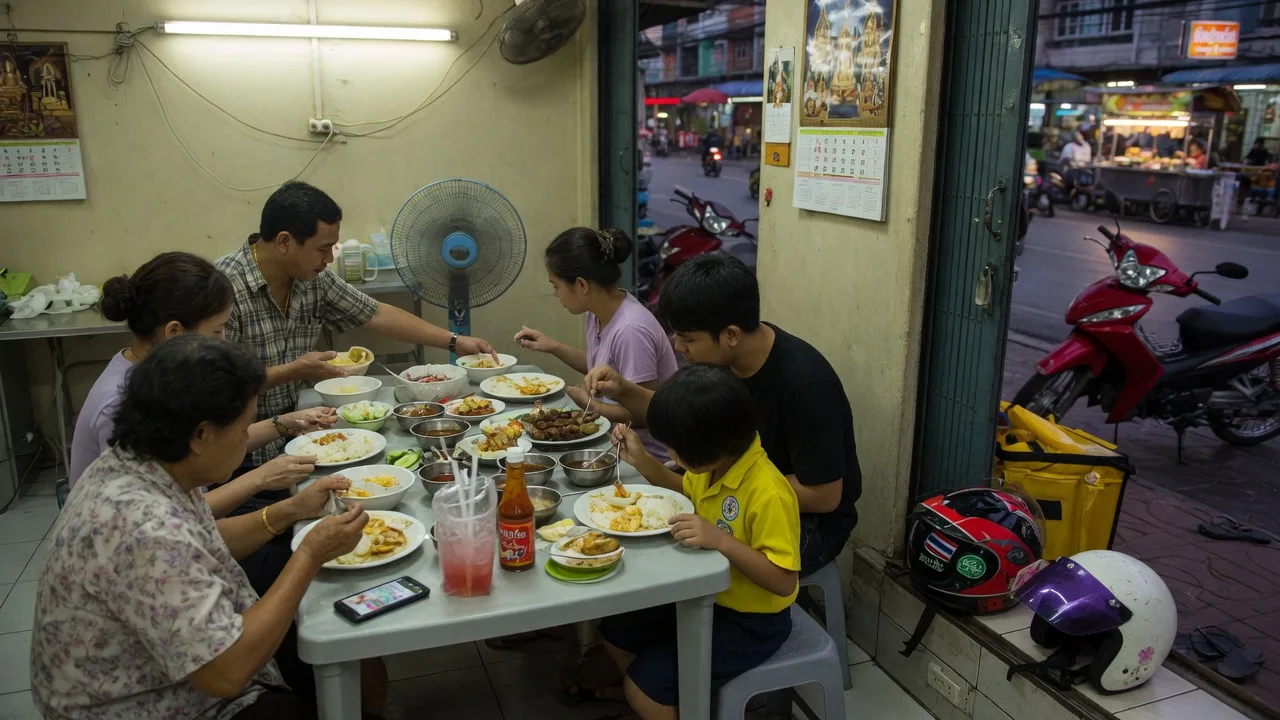
Thai society runs on codes that are invisible if you only packed English. Hierarchy, face, consideration, and a serious commitment to enjoyment sit under every transaction. You do not need a degree. You need to watch who sits where, who speaks second, and why a smile is not always happiness.
The deep cut on not imposing is Kreng jai. Language particles: Gateway Language survival. Wats: Temple etiquette.
Hierarchy

Every relationship has a senior and a junior — age, rank, money, education, title. It shows up in pronouns, in who may sit higher, in who pours whose water.
- Pee (พี่) — older/senior, even by a year
- Nong (น้อง) — younger/junior
- Khun (คุณ) — polite Mr/Ms, before the given name
- Khrap / kha — male / female politeness particles
- Rachasap — royal vocabulary, a separate lexicon
Foreigners get slack. Using khrap/kha and khun still reads as a person who noticed.
The wai
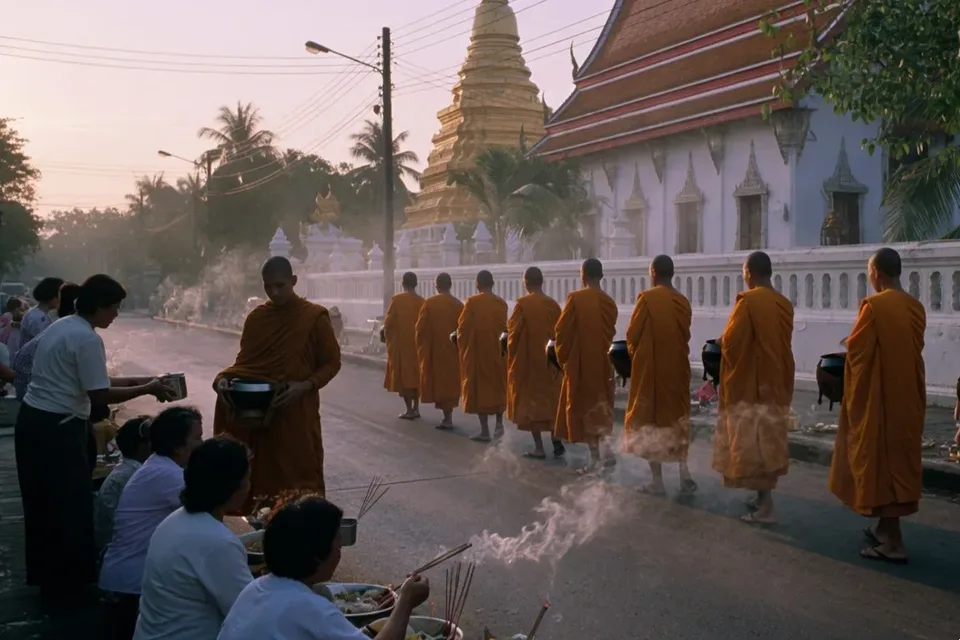
Hands together, slight bow. Height of the hands marks status:
| To whom | Hands | Notes |
|---|---|---|
| Equal | Chest | Default visitor return |
| Senior | Toward the nose, deeper | |
| Monk / royal image | Forehead | |
| Children, cashiers | Do not initiate a theatrical wai | A nod is enough |
| Monk, as a layperson | They do not return a wai to you | Do not wait for one |
Women still do not hand objects directly to monks. Buddhism in Thailand.
Face (sia na)
Losing face (sia na, เสียหน้า) is dignity, reputation, standing. Public criticism, a raised voice, trapping someone with no exit — that costs the relationship, sometimes permanently.
- Criticism is oblique: hints, a third person, time
- Anger is weakness. Jai rawn (hot heart) loses your face too. Shouting at a driver is not assertive
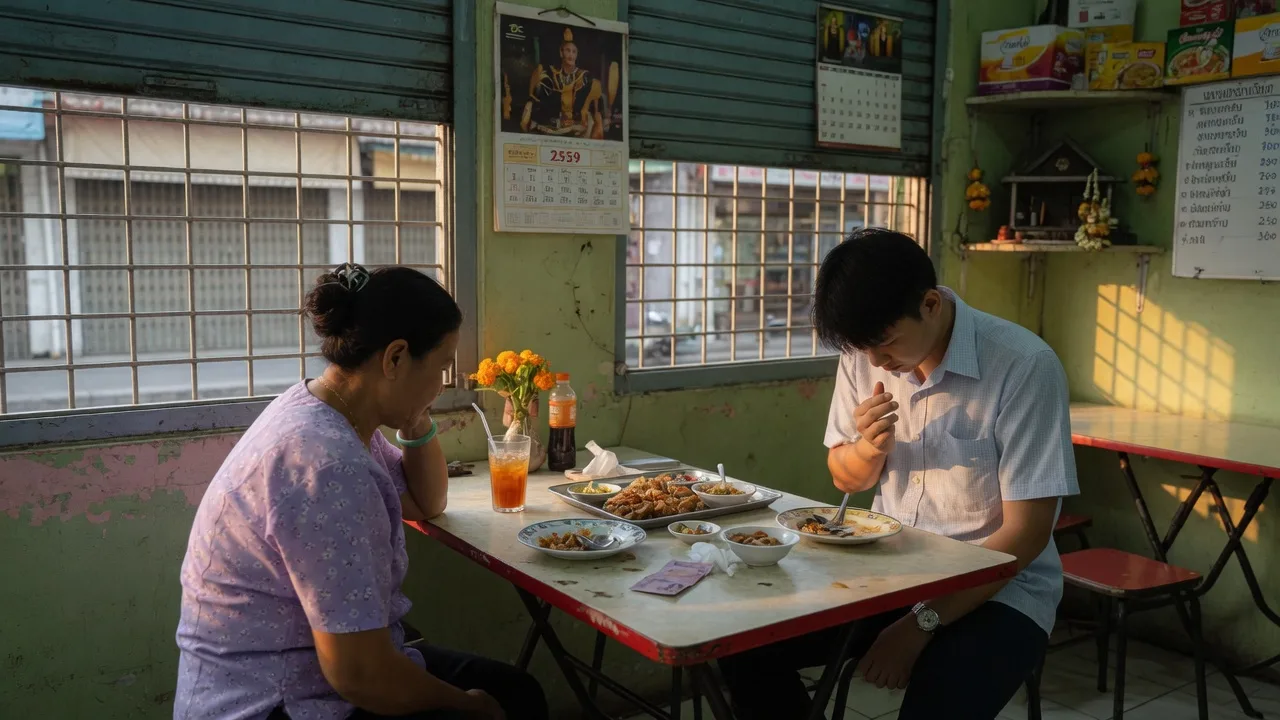
- The smile can be embarrassment, a boundary, a defuse — not only joy
- “No” arrives as “maybe,” “it’s difficult,” a subject change, or a smile
| Situation | What you see | A better move |
|---|---|---|
| Last fruit on the plate | Nobody takes it | Host serves, or you split |
| Wrong dish | Smile, eat around it | Quiet word, not a speech |
| Taxi route | “Yes,” then a detour | Pin the map; thank the correction |
| Hotel problem | “Never mind” | Specific, calm, private |
| Meeting | Silence after “any questions?” | Ask later, one-to-one |
Four values you will meet by lunch
Kreng jai (เกรงใจ) — do not impose, even at cost to yourself. The other side is supposed to notice and refuse to let you absorb it. When only the visitor “is fine on the floor,” the host dies inside. Full page: Kreng jai.
Sanuk (สนุก) — life should contain enjoyment. Work too. Serious topics get a joke so the room can keep its face. Not frivolity; social hygiene.
Jai yen (ใจเย็น) — cool heart. The ideal temperament. When the booking is wrong, the Thai move is calm, a smile, a path forward. British “I demand to speak to the manager” is a different sport.
Mai pen rai (ไม่เป็นไร) — never mind, it’s OK. Lets a spill go. Not the same as kreng jai (which prevented the spill being mentioned) and not the same as face (which is why it was not mentioned).
Family
Khrop khrua is the unit. Multi-generational houses are ordinary. Children support parents; a son’s ordination makes merit especially for the mother. The eldest often carries ageing parents.
Everyone has a chue len (play name): Noi, Lek, Boom, Ice, Golf. Official names are for forms. Language survival.
Monarchy sits above this stack as a national parent. Do not test that metaphor as a joke. The monarchy.
What is moving
- Urbanisation — Bangkok and regional cities pull the young; village structures thin
- Education and feeds — global culture in the pocket
- LGBTQ+ — relatively visible by regional standards; kathoey have a public role; 2024 same-sex marriage — first in Southeast Asia
- 2020–2021 protests — a younger cohort willing to question hierarchy and, riskily, the monarchy
- Inequality — Bangkok wealth versus rural poverty is not a closed chapter
Festivals still pull people home: Songkran 13–15 April 2026 is the big migration; Loy Krathong 24 November 2026 is the river night. Songkran, Loy Krathong.
At the table, finishing a dish with the condiment tray is participation, not a complaint. Sending food back because it is “not spicy enough” is the insult; the caddy was already there. Table & Bazaar: How to order, Chilli and condiments. A linen scarf for the wat — scarf listings are colour and size menus, so this stays a search; slip-on shoes for the threshold; manners for the rest.
Ordination still makes merit for parents. Most Thai men are expected to wear the robe at least once. Treat the teenager in saffron as the robe, not as a cousin on a gap year. Buddhism in Thailand, Temple etiquette.
Next
Kreng jai, Temple etiquette, Language survival, Buddhism in Thailand, Etiquette.