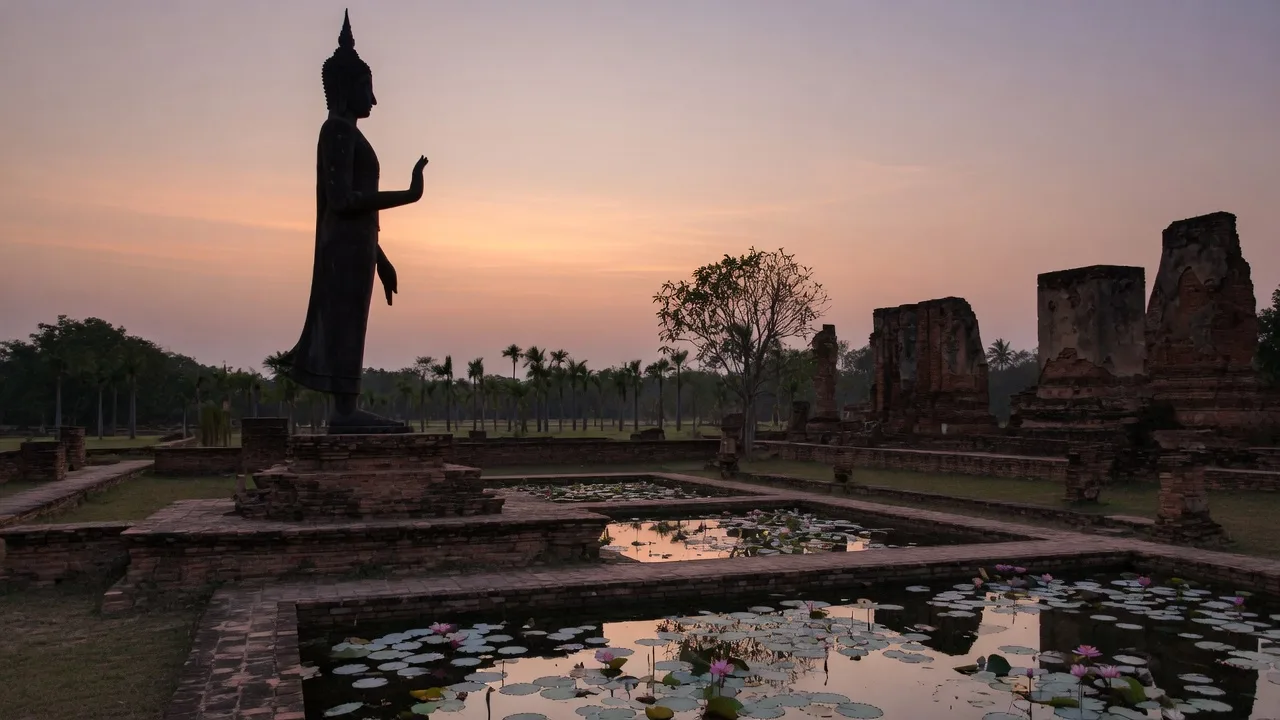
Sukhothai (สุโขทัย, "Dawn of Happiness") occupies an almost mythic place in Thai national identity. Founded around 1238 when two Thai chieftains declared independence from Khmer overlordship, Sukhothai is traditionally revered as the first Thai kingdom — the birthplace of the Thai script, the codification of Theravada Buddhism as the state religion, and the creation of a political ideal of the benevolent Buddhist king that continues to shape Thai governance to this day.
The Sukhothai era was relatively brief — the kingdom's golden age lasted barely a century — but its cultural legacy is immense and its ruins are among the most beautiful and atmospheric in Southeast Asia.
The Founding
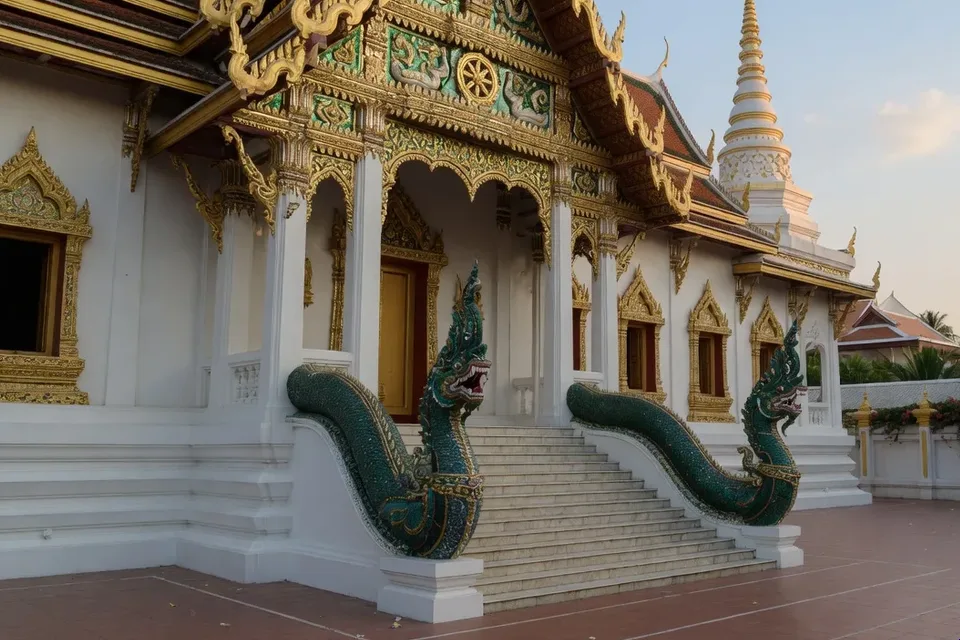
In 1238, according to tradition, the Thai chieftains Pho Khun Bang Klang Hao and Pho Khun Pha Muang overthrew the Khmer governor at Sukhothai and established an independent Thai kingdom. Pho Khun Bang Klang Hao took the throne as Sri Indraditya, the first king of the Sukhothai dynasty.
The timing was significant: the Khmer Empire was weakening, and Tai-speaking peoples were asserting independence across the region. Sukhothai was the most prominent of several nascent Thai kingdoms.
Ramkhamhaeng the Great (r. c. 1279–1298)
The third king of Sukhothai, Ramkhamhaeng (พ่อขุนรามคำแหง), is the figure most closely associated with the kingdom's golden age and one of only three Thai monarchs to receive the epithet "the Great."
The Ramkhamhaeng Inscription (1292)
The most famous artefact from the Sukhothai era is a stone inscription attributed to Ramkhamhaeng, traditionally dated to 1292. Written in what is identified as the earliest Thai script, the inscription describes:
- The invention of the Thai writing system — Ramkhamhaeng is credited with devising the Thai script, adapted from Khmer and Mon scripts, around 1283. The modern Thai alphabet derives from this system.
- A prosperous, well-governed kingdom — "In the water there is fish, in the fields there is rice" — the famous phrase describing Sukhothai as a land of abundance.
- Free trade — The inscription describes a kingdom where anyone could trade freely, with no taxes on the market.
- Open justice — A bell was hung at the palace gate; any subject with a grievance could ring it, and the king would personally hear their case.
- Theravada Buddhism as the state religion — The inscription describes the king's devotion to Buddhist principles and his patronage of monks and temples.
The Ramkhamhaeng Inscription is now a UNESCO Memory of the World document. However, some scholars have questioned its authenticity, arguing it may have been created or embellished in a later period. The debate is unresolved, but the inscription's status as a foundational Thai national document is undiminished.
Political Achievements
Under Ramkhamhaeng, Sukhothai expanded to control a territory that included much of modern central and northern Thailand, parts of Laos, and areas reaching to the Malay Peninsula. He formed alliances with neighbouring kingdoms, including a reported friendship with Mangrai (founder of Lanna/Chiang Mai) and Ngam Muang (ruler of Phayao).
Ramkhamhaeng also sent envoys to China and is recorded in Chinese sources as "the king of Siam" — one of the earliest uses of the name that Europeans would later apply to the Thai kingdom.
Buddhism and Culture
The Sukhothai era established Theravada Buddhism as Thailand's dominant religion — a position it has held ever since.
Sri Lankan Buddhism
Sukhothai monarchs invited monks from Sri Lanka (then the centre of Theravada orthodoxy) to reform and strengthen Buddhist practice. This connection ensured that Thai Buddhism followed the Theravada Pali Canon tradition, distinguishing it from the Mahayana Buddhism prevalent in China, Vietnam, and Korea.
Sukhothai Art
The artistic production of the Sukhothai era is considered the highest expression of Thai Buddhist art. Sukhothai-period Buddha images are immediately recognisable:
- Walking Buddha — A uniquely Thai innovation. Sukhothai sculptors depicted the Buddha in a graceful walking posture, with one foot forward and hands in the abhaya (fearlessness) mudra. The Walking Buddha of Sukhothai is one of the most reproduced images in Thai art.
- Facial features — Oval face, aquiline nose, subtle smile, flame-shaped ushnisha (cranial protuberance) — an idealised beauty that defined Thai religious art for centuries.
- Bronze casting — Sukhothai workshops produced technically superb bronze Buddha images, many of which survive in museums and temples across Thailand.
Temple Architecture
Sukhothai temples feature distinctive elements:
- Lotus-bud finials on chedis (stupas)
- Khmer-influenced prang towers adapted to Thai aesthetic sensibilities
- Laterite (ironstone) foundations with brick superstructures
- Reflecting pools and moats integrating temples into the landscape
Sukhothai Historical Park
The ruins of Sukhothai are protected as a UNESCO World Heritage Site (inscribed 1991). The Sukhothai Historical Park covers 70 km² with approximately 200 temple ruins spread across five zones.
Key Sites
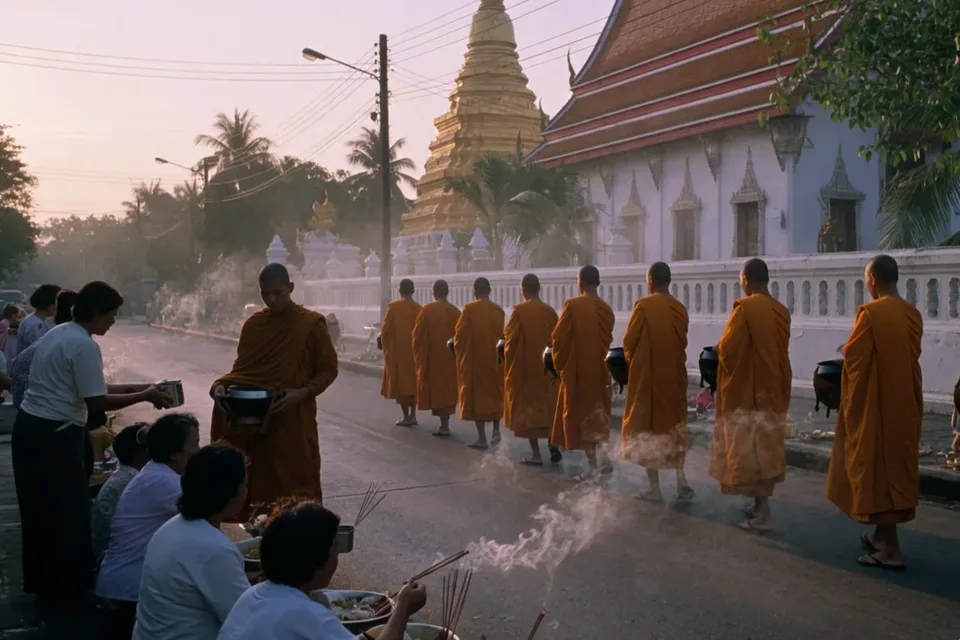
- Wat Mahathat — The royal temple and spiritual heart of the kingdom. An enormous complex with a central lotus-bud chedi surrounded by smaller chedis, prayer halls, and standing/walking/seated Buddha images. Atmospheric at sunset.
- Wat Si Chum — Houses a colossal seated Buddha image, 15m tall, with an enigmatic face visible through a narrow slit in the enclosing walls. One of the most photographed images in Thailand.
- Wat Sa Si — A small but perfectly proportioned temple set on an island in a reflecting lake. Classic Sukhothai elegance.
- Wat Trapang Thong — A temple on the edge of a reflecting pool, with a footprint of the Buddha housed in a mondop (square shrine).
- Ramkhamhaeng National Museum — Houses the Ramkhamhaeng Inscription, Sukhothai-era Buddha images, ceramics, and historical artefacts.
Visiting Tips
- Cycling is the best way to explore. Bicycles are available for hire at the park entrance.
- The park is vast — allow at least half a day, ideally a full day.
- Loy Krathong (November full moon) celebrations at Sukhothai are among the most beautiful in Thailand — the ruins are illuminated, floating lanterns drift above the lakes, and traditional performances animate the ancient city.
Si Satchanalai and Kamphaeng Phet
Two satellite cities are also UNESCO-listed:
- Si Satchanalai Historical Park — 55km north of Sukhothai. Less visited and more atmospheric, with temple ruins scattered through forest. The adjoining Chaliang and Ban Ko Noi sites preserve ceramic kilns from a renowned Sukhothai-era pottery industry.
- Kamphaeng Phet Historical Park — A fortified city to the south, with substantial laterite ruins and a more rugged, overgrown character.
Decline
After Ramkhamhaeng's death (c. 1298), Sukhothai entered a gradual decline. Succession disputes, loss of tributary states, and the rise of the more powerful Ayutthaya kingdom to the south eroded Sukhothai's independence. By 1438, Sukhothai had been fully absorbed into the Ayutthaya kingdom.
But its cultural contributions endured: the Thai script, the Theravada Buddhist state tradition, the artistic and architectural vocabulary, and the ideal of the just and compassionate Buddhist king all passed from Sukhothai into the foundation of subsequent Thai kingdoms.