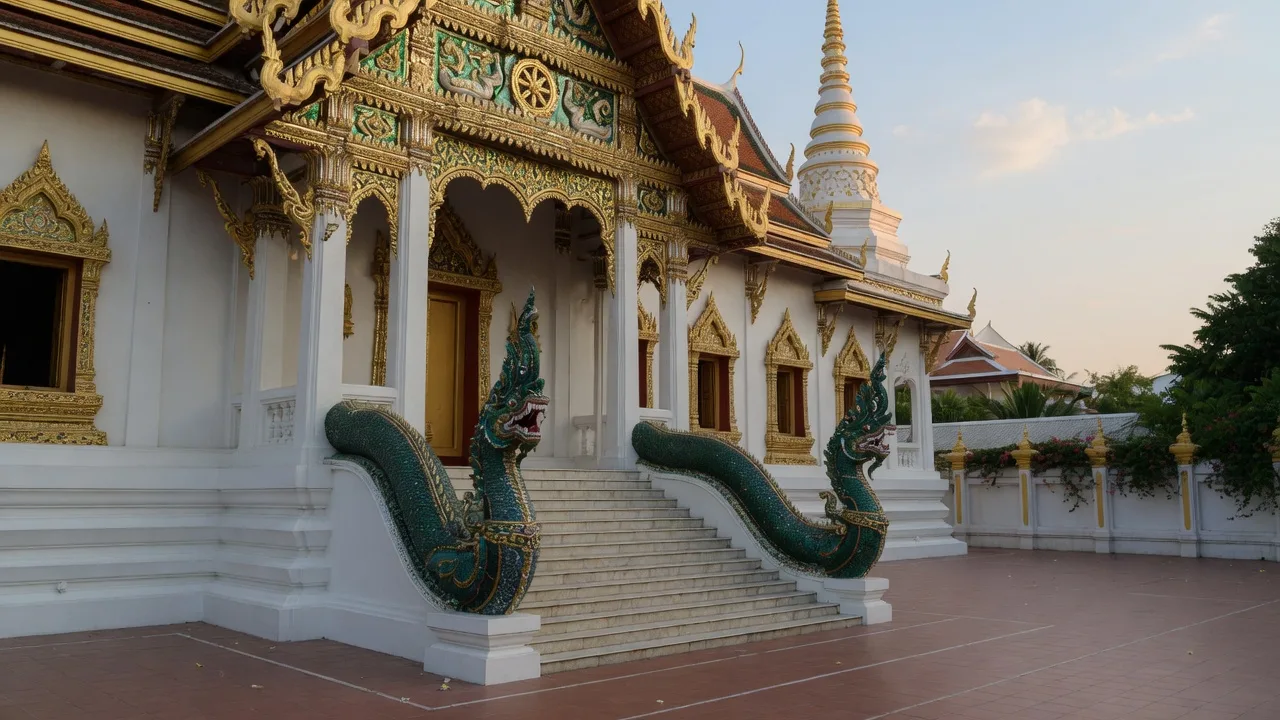
Thailand has over 40,000 Buddhist temples (wat) — more than any other country on Earth. They range from glittering royal complexes encrusted in gold leaf and mirror mosaic to simple wooden structures in rural villages where a single monk serves a farming community. Collectively, they form the spiritual, architectural, and social backbone of the nation.
Bangkok's Great Temples
Wat Phra Kaew & The Grand Palace
The Temple of the Emerald Buddha (Wat Phra Kaew) is Thailand's most sacred temple. Located within the grounds of the Grand Palace — the ceremonial residence of the monarchy since 1782 — the temple complex is a dazzling assault on the senses: golden chedis, mosaic-encrusted pillars, demon guardians, murals depicting the Ramakien (the Thai version of the Ramayana), and at its heart, the Emerald Buddha — a 66cm jade figure dressed in gold seasonal costumes changed by the king himself three times a year.
The Grand Palace complex covers 218,000 m² and includes the temple, the former royal residence (Chakri Maha Prasat Hall, a remarkable fusion of European and Thai architecture), coronation halls, and gardens. It is Bangkok's single most-visited sight and Thailand's architectural showpiece.
Visitor notes: Entry fee 500 THB. Strict dress code (no shorts, sleeveless tops, or sandals — rental cover-ups available, or bring a linen scarf). Very crowded; arrive at opening (08:30) for the best experience.
Wat Pho — Temple of the Reclining Buddha
Adjacent to the Grand Palace, Wat Pho (officially Wat Phra Chetuphon) houses a 46-metre reclining Buddha — one of the largest in Thailand — gold-leafed and lying on its side in a hall barely big enough to contain it. The feet alone are 3 metres wide, inlaid with 108 auspicious symbols in mother-of-pearl.
Wat Pho is also the birthplace of traditional Thai massage — the temple contains inscriptions and diagrams detailing massage techniques, and a school within the temple grounds still trains practitioners. Visitors can receive an excellent (and vigorous) traditional massage for a modest fee.
Wat Arun — Temple of Dawn
Rising from the west bank of the Chao Phraya River, Wat Arun's central prang (Khmer-style tower) is Bangkok's most recognisable silhouette. The 82-metre structure is covered entirely in colourful Chinese porcelain fragments and seashells — a dazzling mosaic that catches the light differently at every hour. Visitors can climb steep stairs to a terrace partway up the main prang for river views.
Wat Traimit — Temple of the Golden Buddha
Houses the world's largest solid gold Buddha image — 5.5 tonnes of pure gold, worth approximately US$250 million. The statue was discovered accidentally in 1955 when a plaster-covered Buddha image was being moved and the plaster cracked, revealing the solid gold beneath. The golden Buddha had been disguised with plaster centuries earlier — probably to hide it from Burmese invaders during the destruction of Ayutthaya.
Northern Temples
Wat Phra That Doi Suthep, Chiang Mai
Chiang Mai's most important temple sits at 1,676 metres on the mountainside above the city. A 306-step naga (serpent) staircase leads to a golden chedi visible from the city below. The temple is a active pilgrimage site — particularly on Visakha Bucha day, when thousands make the climb carrying candles.
Wat Chedi Luang, Chiang Mai
A massive ruined chedi in Chiang Mai's old city centre. Originally 86m tall (one of the tallest structures in the Lanna kingdom), it was damaged by an earthquake in 1545 and has remained partially restored. The Emerald Buddha was housed here before being moved to Laos and eventually Bangkok.
The White Temple — Wat Rong Khun, Chiang Rai
A contemporary temple designed by Thai artist Chalermchai Kositpipat. Not a traditional wat but a living art installation — an entirely white, mirror-glass-encrusted structure representing Buddhist purity, surrounded by hands reaching up from hell, pop culture murals (Superman, the Matrix, the Twin Towers), and a golden toilet building. Bizarre, spectacular, and unlike anything else in Thailand.
Monastic Daily Life
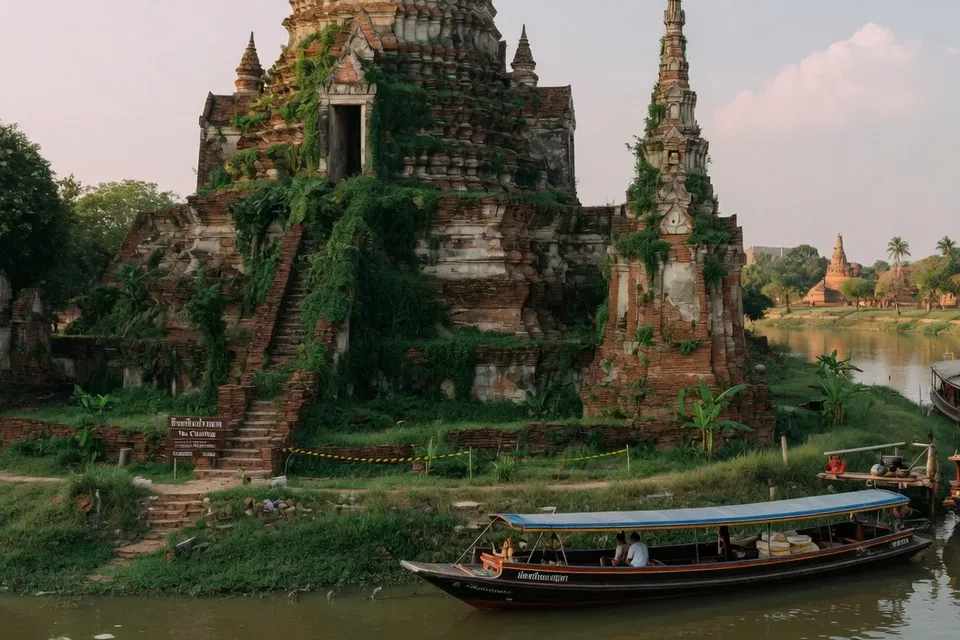
Thailand's approximately 300,000 monks follow daily routines rooted in the Vinaya (monastic rules) laid down in the Pali Canon:
| Time | Activity |
|---|---|
| 04:00 | Wake, morning chanting, meditation |
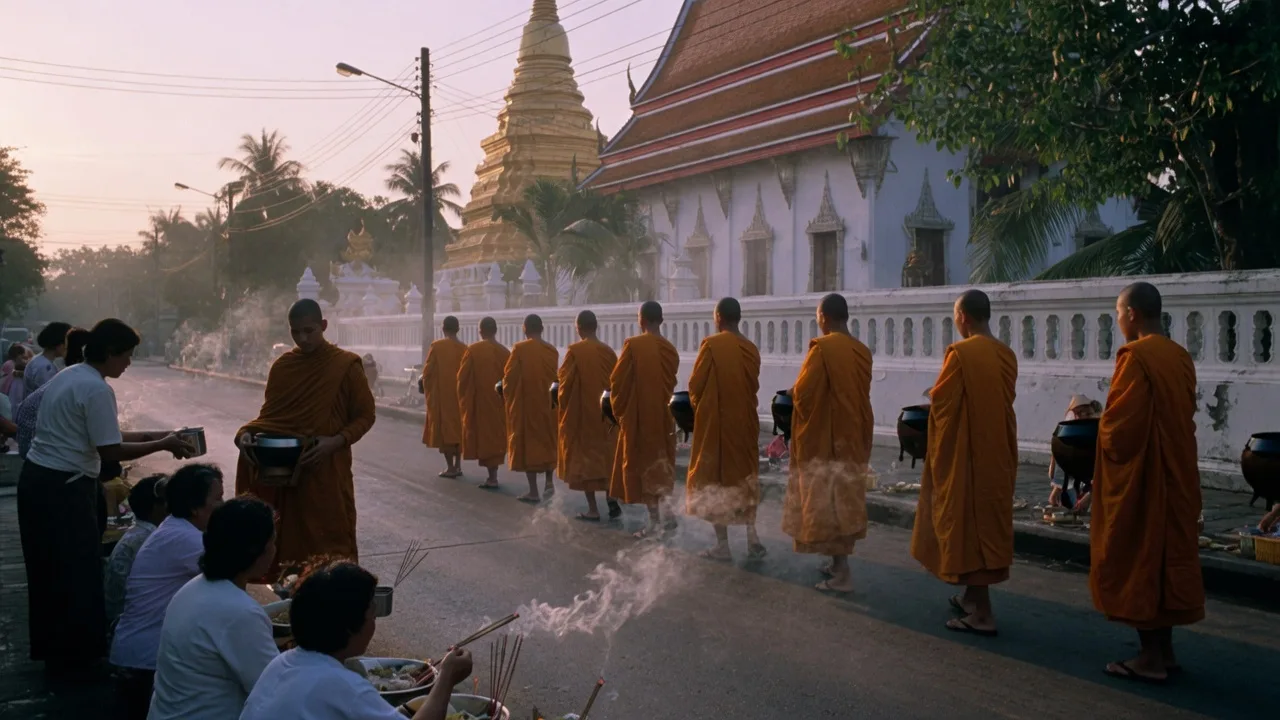
| 06:00–07:00 | Alms round (bintabaht) — walking barefoot through the community |
| 07:00–08:00 | First meal (the main meal of the day) |
| 08:00–11:00 | Study, temple duties, community service |
| 11:00–12:00 | Second and final meal (no food after noon) |
| 12:00–17:00 | Study, meditation, teaching, temple maintenance |
| 17:00–18:00 | Evening chanting |
| 18:00–21:00 | Study, meditation, personal time |

Key Rules
- No eating after noon (until the following dawn)
- 227 precepts govern conduct (for fully ordained monks)
- No handling money — lay supporters manage temple finances
- Women must not touch monks — any physical contact, even accidental, requires the monk to undergo purification
- Orange/saffron robes — the colour varies by region and sect, from bright orange to dark brown
- Shaved head and eyebrows — renewed every Buddhist holy day
Monk Chat
Many temples, particularly in Chiang Mai, offer Monk Chat programs — informal conversations between monks (often young novices practicing English) and visitors. These sessions offer genuine insight into monastic life, Buddhist philosophy, and Thai culture. Wat Chedi Luang and Wat Suan Dok in Chiang Mai are popular monk chat locations.
The Two Sects
Thai Buddhism has two main monastic orders:
- Maha Nikaya — The larger, more populous order. More relaxed in interpretation of rules. Most rural temples belong to this sect.
- Dhammayut — The reform order, founded by King Mongkut (Rama IV) in 1833 to return to a stricter interpretation of Pali Canon rules. The royal family and aristocracy have traditionally been associated with Dhammayut temples.
Forest Tradition
The Thai Forest Tradition (Kammaṭṭhāna) is a meditation-focused movement that emerged in the early 20th century. Forest monks:
- Practice in wilderness settings, often in caves or simple huts
- Emphasise meditation over scholarly study
- Follow strict ascetic practices (dhutanga) — eating once daily, living under trees, wearing robes made from discarded cloth
- Attracted Western interest: the teachings of masters like Ajahn Chah and Ajahn Mun have been translated widely, and several forest monasteries welcome international practitioners
Wat Nong Pah Pong (Ubon Ratchathani) — Ajahn Chah's monastery — and its branch Wat Pah Nanachat (the "International Forest Monastery") welcome foreign monks and lay meditators.