Short answers for this culture guide: dress, dates, monks, monarchy, and the social habits that are not “optional flavour”. Practical visas and SIMs live on Gateway. Coasts and park fees live on Land & Sea. The table lives on Table & Bazaar.
What do I wear to a temple?
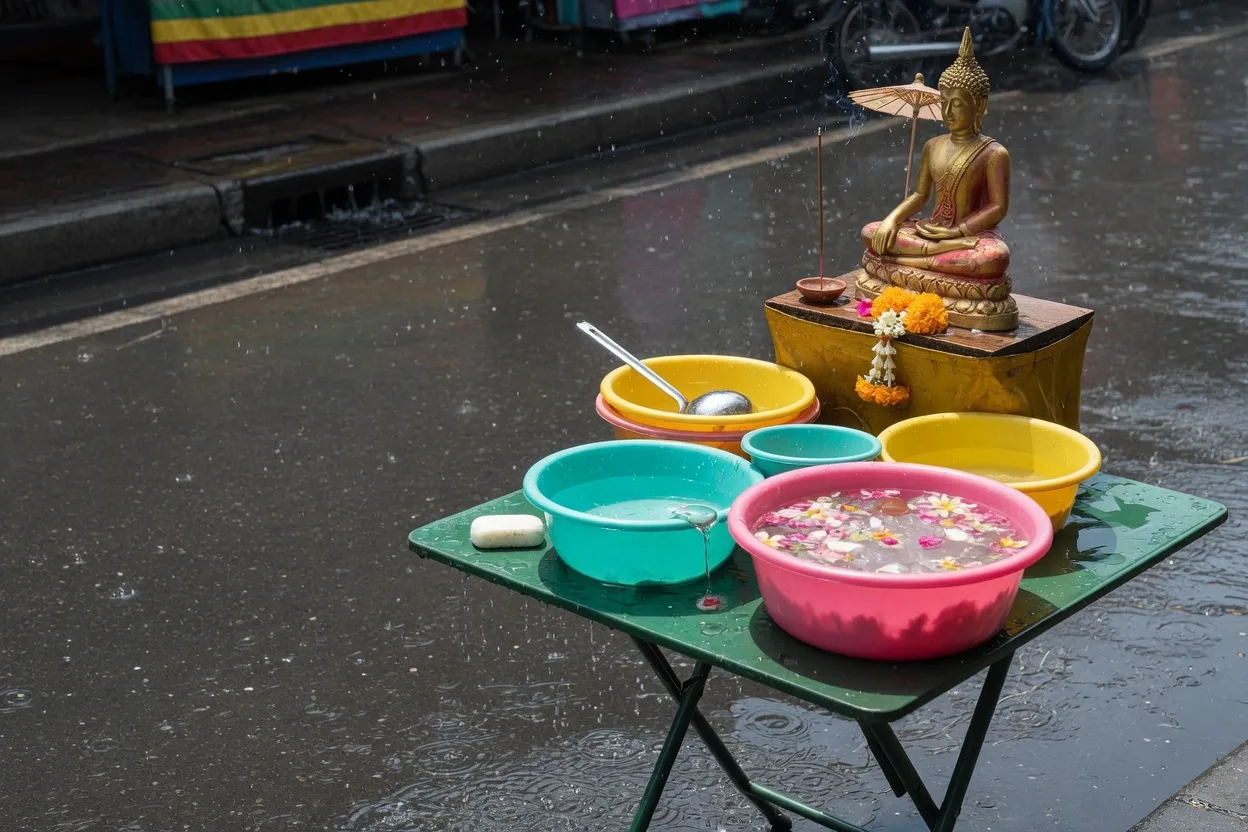
Cover shoulders and knees. Shoes off in any hall with a Buddha image. Hats off. Sunglasses off if you are sitting for more than a snapshot. Tank tops and ripped shorts fail royal wats and a surprising number of ordinary ones. A light scarf in the bag solves most gates; neighbourhood wats are kinder, not optional. Full sequence: Temple etiquette.
Can I photograph monks?
Ask, or don’t. Never pose a monk as a prop, a peace-sign extra, or a beer-ad. Women do not hand objects directly to monks — tray, cloth, or ground. Give space on the BTS. A morning alms round is not a content shoot. The teenager in saffron may be on a two-week ordination, not a career. Treat the robe. Details under Temples and monks.
When is Songkran in 2026?
Officially 13–15 April 2026. Thai New Year. Water is the public face; family, elders, and a wat visit are the point. Bangkok empties; islands and remaining tourist streets fill. Chiang Mai often runs extra days. Book transport early. Songkran.
When is Loy Krathong in 2026?
24 November 2026, on the full moon of the twelfth lunar month. You float a krathong. Northern lantern releases (Yi Peng) overlap in Chiang Mai and follow local rules that change — do not copy a 2016 photo over an airport. Loy Krathong and the Thai calendar.
Why is the monarchy sensitive?
Lèse-majesté is statute, not a mood. Do not joke about the king, the royal family, or a sacred image as a punchline — in a bar, in a caption, in a group chat that sits on a Thai SIM. Stand for the royal anthem in a cinema. Do not treat currency as a doormat; it carries the king’s image. We describe the institution; we do not run a debating society. The monarchy.
What is kreng jai?
Consideration that looks like hesitation: not imposing, not taking the last of something, not contradicting a host in public. It is not the same as mai pen rai (“let it go”) and it is not “face”, which needs an audience. Do not “just be honest” at volume in a lobby. A calm, specific request leaves everyone a corridor. Kreng jai.
What is a wai, and must I do it?
A wai is palms together, a slight bow. Height of the hands tracks respect. You are not required to wai every cashier. Returning a wai from a hotel host is courteous. Do not wai while holding a drink and a camera; a nod will do. Staff who wai as a greeting are working, not inviting a ritual seminar.
Can I buy beer on Buddhist holy days?
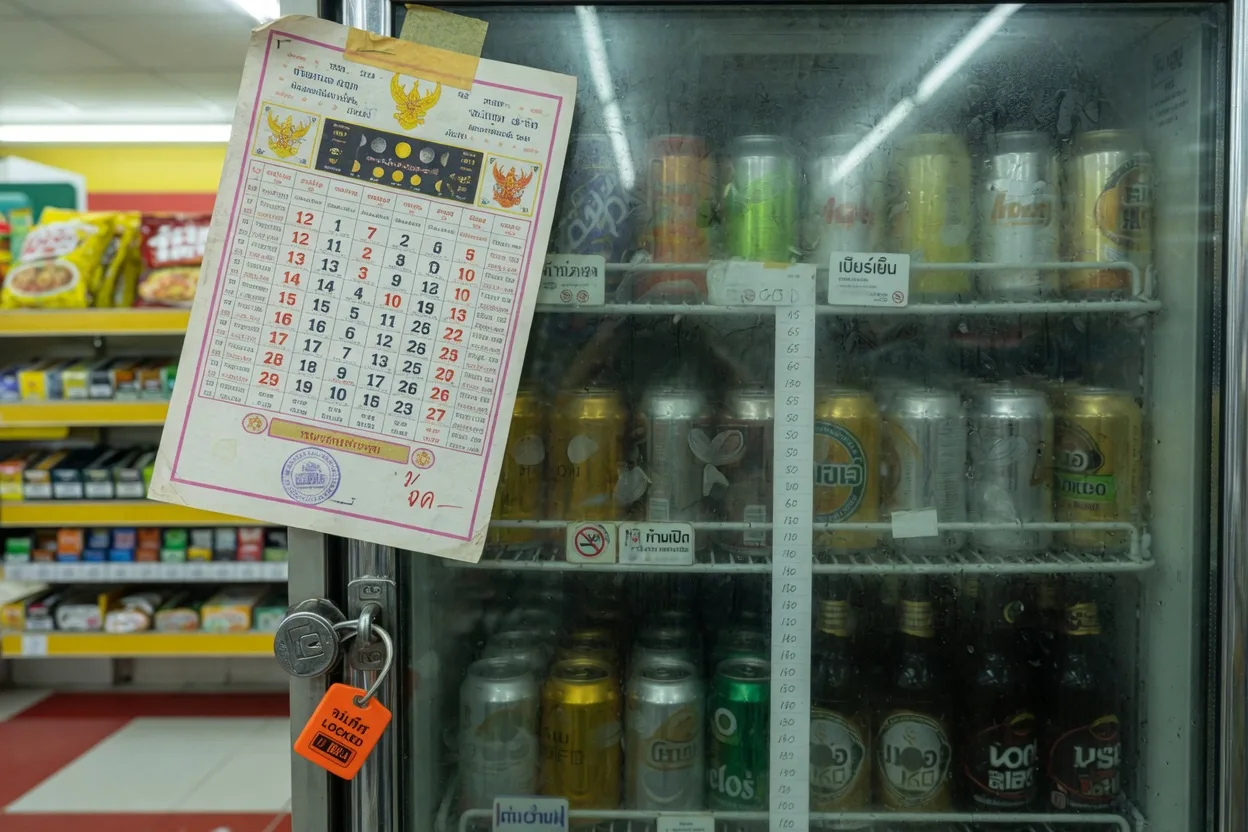
Not on the major ones. Makha Bucha, Visakha Bucha, Asarnha Bucha, Khao Phansa, and Ok Phansa are dry for shops nationwide. Ordinary wan phra (lunar observance days, several per month) fill the wats; they are not all automatic dry days. Check a current Thai calendar before you plan an evening around a bottle. Hours and advertising rules: Thai Beer & Spirits. Calendar logic: Thai calendar.
Do I take shoes off everywhere?
Halls with a Buddha image: yes. Many homes: yes. Some shops and every wat courtyard: watch for the pile. A restaurant that is just a restaurant: usually no. Do not stack shoes on a chedi plinth. Wear something you can slip in three seconds; laces on hot stone is how people skip the rule.
How does the Buddhist Era year work?
BE = CE + 543. 2026 is 2569 BE. Tickets and government paper often use BE; passports and airlines use CE. Both can be correct on the same day. Thai calendar.
I am a woman visiting a wat — what is extra?
The dress line is the same (shoulders, knees). Do not touch a monk or pass an item hand-to-hand. Sit with a gap. Do not take the BTS seat immediately beside a monk if another is free. You do not have to kneel if your knees will not; do not tower over a seated row with a camera. Temple etiquette.
Is it rude to say no?
No. It is rude to say yes and then vanish, or to force someone else to say no in front of their staff. Decline once, clearly, with thanks. In a service setting, offer two acceptable options instead of an open “whatever you think”. That is kreng jai as a visitor, not as a doormat. Kreng jai and Gateway’s etiquette guide.
| Topic | 2026 fact to keep | Where it lives |
|---|---|---|
| Songkran | 13–15 April | Songkran |
| Loy Krathong | 24 November | Loy Krathong |
| Year stamp | 2569 BE = 2026 CE | Thai calendar |
| Temple dress | Shoulders and knees; shoes off in the hall | Temple etiquette |
| Dry holy days | Makha, Visakha, Asarnha, Khao Phansa, Ok Phansa | Thai calendar |
Planning, parks, and plates are the other three pillars: Gateway, Land & Sea, Table & Bazaar. Corrections for this site: About.